Hello everyone.
I'm Andy, a tea enthusiast.
When you buy tea, do you ever look closely at the label on the package?
Today I would like to share what to pay attention to in Taiwan's tea labeling rules.
The conclusion first: a properly labeled pack of Taiwan-grown tea should show at least the product name,
ingredients, net weight, company information, country of origin,
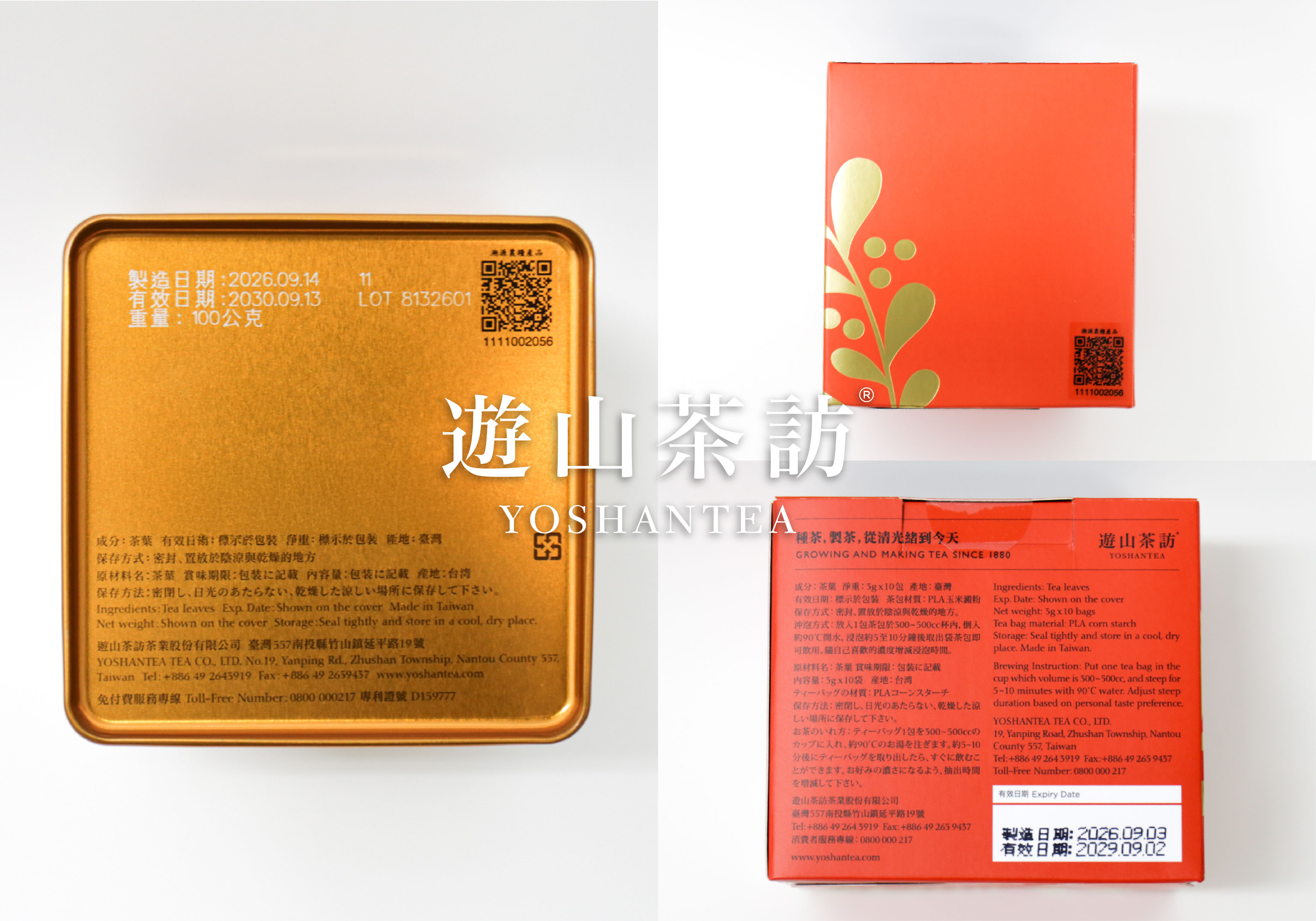
and expiry date, plus a traceability QR Code (or a TAP mark or an organic mark).
The label must be in Traditional Chinese, the text must be large enough,
and the expiry date must be printed directly on the package or label.
Why does labeling matter so much?
Consumers have the right to know. For tea, the two most important items are the expiry date and the ingredient list.
When imported tea is blended with Taiwan tea, the countries of origin must be listed in descending order of proportion.
Food safety concerns have also changed.
People used to ask "Is it safe to consume?" Now they also ask "Am I being misled?" This is the issue of Food Fraud.
Clear labeling is the most basic form of honesty toward consumers.
What must appear on a tea package?
Under Article 22 of the Act Governing Food Safety and Sanitation, packaged food must clearly show the following items in Chinese and common symbols.
Applied to pure tea, they are:
1. Product name: the true name of the product.
2. Ingredients: when two or more are mixed, listed from highest to lowest content.
3. Net weight, volume, or quantity.
4. Food additives: pure tea contains none, so nothing needs to be listed.
5. Name, telephone number, and address of the manufacturer or the responsible domestic company.
6. Country of origin.
7. Expiry date.
8. Nutrition labeling: pure tea is exempt, as explained in the next section.
9. Genetically modified ingredients: tea is not a genetically modified product, so no labeling is needed.
We recommend writing the expiry date as "有效日期 (Expiry Date): YYYY MM DD.
" Please avoid other wording such as "best before." "有效日期" is the most accurate term.
Does tea need a nutrition label?
No.
According to the Ministry of Health and Welfare's
"Regulations on Prepackaged Food Exempt from Nutrition Labeling"
(March 14, 2018, No. 1071300397, issued under Article 23 of the Act),
tea leaves for brewing that contain no other ingredients or food additives are exempt from nutrition labeling,
as long as no nutrition claims are made.
However, if a customer or retail channel asks for a nutrition label, please provide one.
This is not an unreasonable request. It is something their own management system requires, since only a few food categories are exempt.
Once a nutrition label is provided, it must follow Article 22 of the Act.
Pure Taiwan tea needs one more mark
This is the item most often forgotten.
Under Article 16, Paragraph 3 of the Agricultural Production and Certification Act,
the Ministry of Agriculture announced that domestically produced tea is an agricultural product requiring registered traceability information
(announced October 27, 2022, amended August 22, 2023, No. 1121096129).
For domestic tea produced on or after January 1, 2023, any product labeled with "Taiwan" as its origin must carry one of the following:
1. Traceability QR Code for agricultural products
2. TAP (Traceable Agricultural Products) mark
3. Organic mark
Any one of the three is sufficient.
The purpose of this rule is to prevent imported tea from being mixed in or falsely labeled as domestic tea.
Domestic tea must not be mixed or adulterated with non-domestic tea.
If traceability information is not registered, or the labeling is incomplete or false,
and the issue is not corrected within the given deadline, a fine of NT6,000toNT30,000 may be imposed for each violation.
For consumers, scanning the QR Code shows where the tea comes from.
Three more details to check
Font size
Under Article 19 of the Enforcement Rules of the Act Governing Food Safety and Sanitation,
each character on the label must be at least 2 mm in both height and width.
For small packages with a largest surface area under 80 square centimeters,
items other than the product name, company name, and expiry date may be smaller than 2 mm.
In other words, no matter how small the package is, these three items must stay at 2 mm or larger.
Traditional Chinese is required
Also under Article 19, when a domestically made product uses a foreign language,
Chinese must be primary and the foreign language secondary.
English, Japanese, or Simplified Chinese may appear alongside,
but every legally required item must be shown completely and clearly in Traditional Chinese.
Simplified Chinese is not the script commonly recognized by the public in Taiwan,
so labeling in Simplified Chinese alone is a violation
(Department of Health interpretation No. 85051086, September 18, 1996).
The expiry date cannot be a separate sticker
The expiry date must be printed in non-fading ink.
If the entire Chinese label is a sticker, all items must be on the same label, and the date must be printed on that label as well.
A separate date sticker is not allowed. The label itself must be hard to peel off or replace
(Department of Health interpretation No. 89008873, February 18, 2000).
What are the common violations?
Summing up the points above, the most frequent problems are:
1. Only a manufacturing date is shown, with no expiry date, or the expiry date is marked as unlimited
2. The expiry date is attached as a separate small sticker, or written with other wording
3. The text is smaller than 2 mm
4. Only a foreign language is shown, with no Traditional Chinese
5. Taiwan tea blended with imported tea does not list the origins by proportion
6. Pure Taiwan tea is missing the traceability QR Code, TAP mark, or organic mark
Next time you buy tea, turn the package over and take a look.
Clearly labeled tea is tea you can drink with confidence.
Hope this has been helpful.
See you next time.
References
1. Designation of Domestic Tea as an Agricultural Product Requiring Registered Traceability Information
(Ministry of Agriculture Laws and Regulations Retrieving System, in Chinese)
https://law.moa.gov.tw/LawContent.aspx?id=GL001502
2. Domestic tea produced from January 1, 2023 must carry traceability labeling (Organic Agriculture Information Website, in Chinese)
https://info.organic.org.tw/34051/
#yoshantea #taiwantea #dongdingtea #oolongtea #teafactory #FSSC22000 #safetea #teaknowledge #tealabeling #foodlabeling #expirydate #traceability #foodfraud #foodsafety