Hello everyone, I'm Andy, a tea enthusiast.
The appearance of oolong tea is often considered one of the quality indicators,
including tea leaf color,particle size, powder content, and stem content.
Too many stems are often perceived as a sign of poor quality tea.
Today, I'd like to share:
Does tea with many stems represent poor quality?
Why Do Tea Leaves Have Stems? What Are the Functions of Tea Stems?
Tea stems are originally tender branches that connect young buds,regular leaves, and mature leaves.
In the growth process of tea plants,stems play the role of a "nutrient highway,"
transporting water and minerals absorbed by roots and nutrients produced through photosynthesis
between different parts.
Because tea stems bear this transportation responsibility,
their fiber structure is more robust than leaves.
More importantly, tea stems connect buds and leaves together.
When brewed with boiling water, they create a more balanced flavor.
Here's what you need to know about the flavor characteristics of different tea plant parts:
Young Buds: Rich in polyphenols and caffeine,with a more astringent taste but strong aftertaste
Leaves: Rich in aromatic compounds, high sweetness, but weaker aftertaste
Stems: Clean sweetness
When stems connect these parts together,
brewing with boiling water simultaneously releases the fresh and sweet aftertaste from buds,
the sweet aroma from leaves, and the clean sweetness from stems. Without stem connections,
when buds and leaves separate, problems may occur: brewing only buds results in overly bitter tea;
brewing only leaves produces sweet aroma but lacks depth.
The presence of stems ensures each brew releases the essence of all parts in balance.
Can Tea Stems Be Brewed Directly? What Do Tea Stems Taste Like?
Absolutely. Tea stems are usually roasted,
which uses heat to bring out warm aromas like caramel and nuts.
Tea stems themselves aren't astringent and carry a subtle sweetness with a mild and smooth mouthfeel.
However, since tea stems contain relatively fewer aromatic compounds,
when brewed alone, the aroma is more subdued,
and the aftertaste is less pronounced than tea leaves.
This isn't a flaw but rather a characteristic of tea stems – they're more like the "base note" in tea infusion,
providing stable clean sweetness rather than eye-catching top notes.
What Are the Chemical Components of Tea Stems?
Tea stems are rich in glutamic acid (also called glutamate), an important amino acid that brings the savory "umami" taste.
This flavor can also be experienced in broth, kelp, and aged cheese – it's a round, lasting sweetness.
Additionally, tea stems have relatively lower polyphenol content,
resulting in less bitterness and astringency, and lower caffeine content. Conversely,
tea stems contain more polysaccharides and water-soluble pectin,
which increase the body and sweet smoothness of the tea infusion.
From a compositional distribution perspective:
- Young Buds: High polyphenols (strong astringency), high amino acids (good aftertaste), high caffeine
- Leaves: Rich in aromatic compounds (strong aroma), more sugars (good sweetness), weaker aftertaste
- Stems: Rich in glutamic acid (savory sweetness), low polyphenols (not astringent)
The combination of these three creates a layered, rich cup of tea.
What Are the Classifications of Tea Stems?
During the tea-making process, tea stems actually have various forms.
Understanding these classifications helps us more accurately assess tea quality:
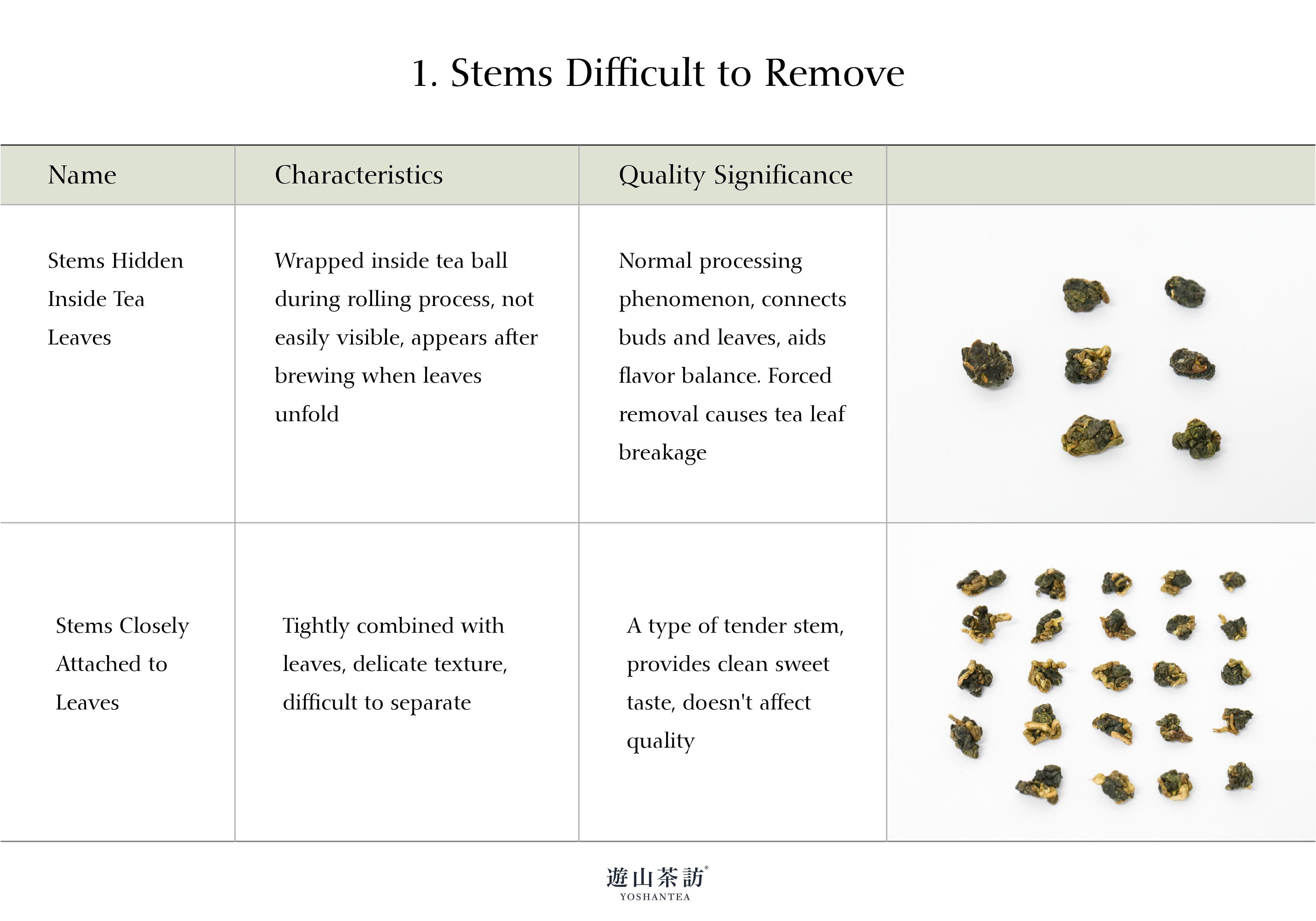
1. Stems Hidden Inside Tea Leaves: Wrapped inside the tea ball during the rolling process, not easily visible from the outside
2. Exposed Tender Stems: Tender branches connecting leaves, with delicate texture
3. Stems Closely Attached to Leaves: Tightly combined with leaves, difficult to separate
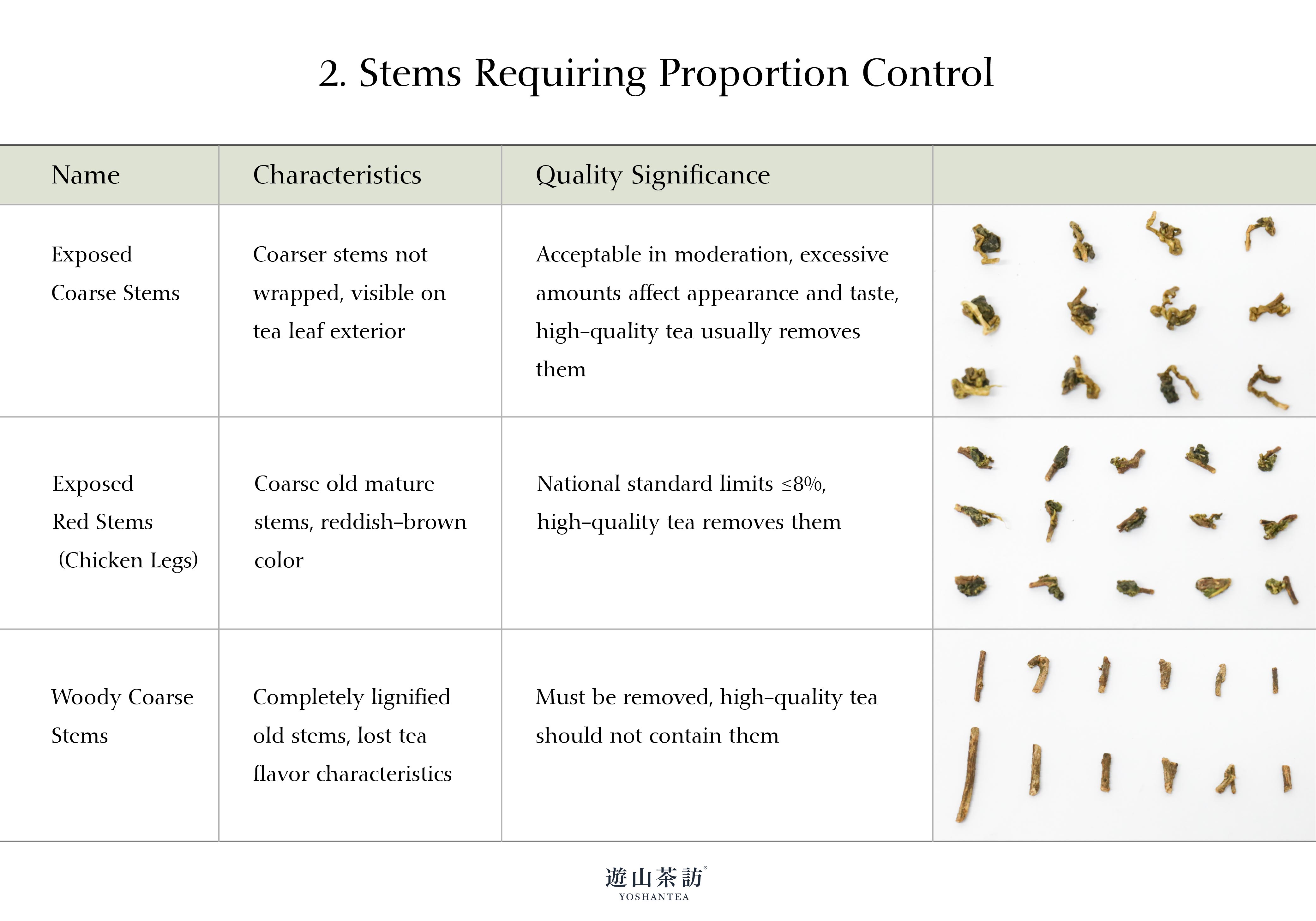
4. Exposed Red Stems (commonly called "chicken legs"): Coarse, woody stems with darker color
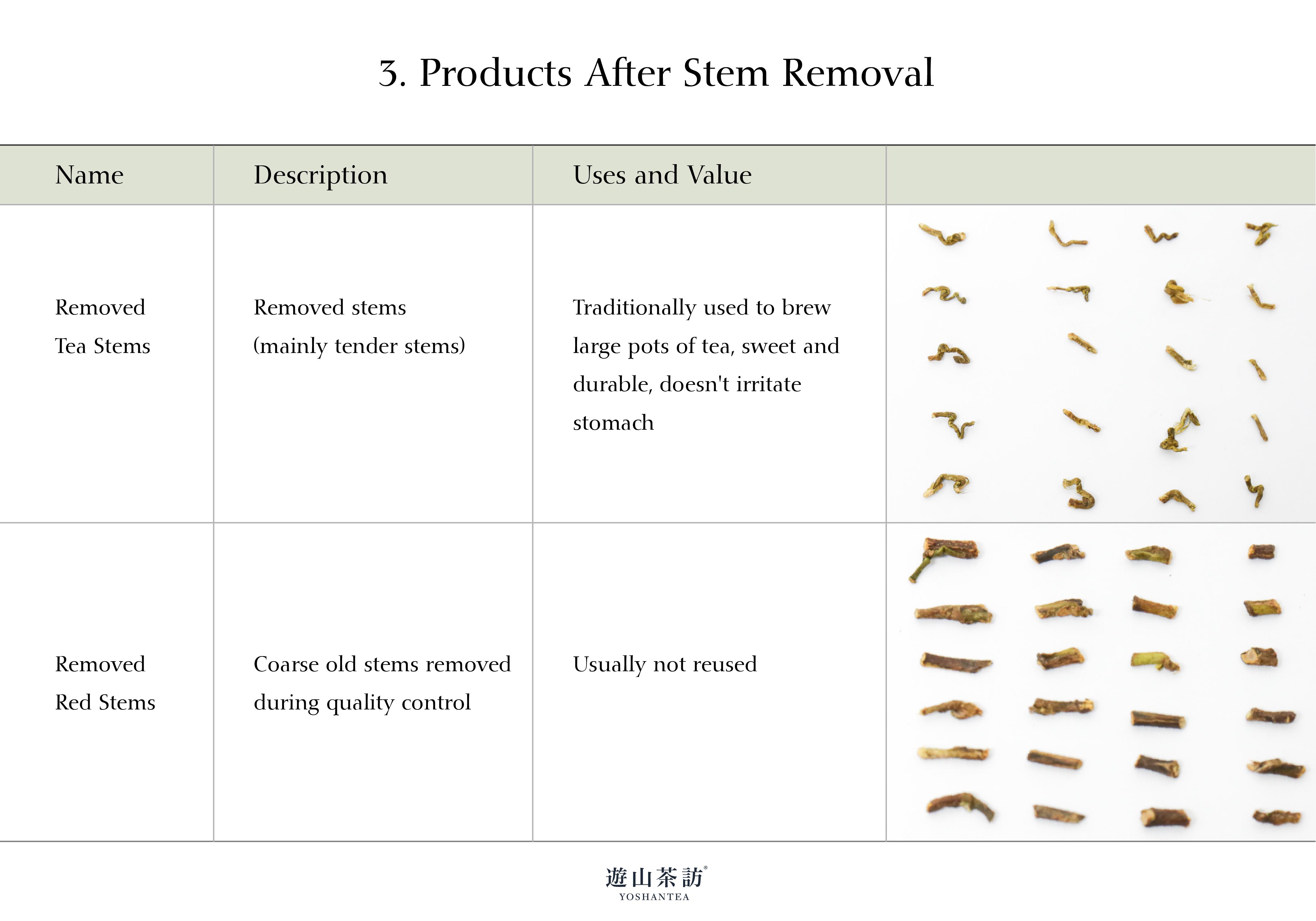
5. Removed Tea Stems: Stems screened out during tea production, traditionally used for separate brewing
6. Removed Red Stems: Coarse old stems removed during quality control
7. Woody Coarse Stems: Completely lignified old stems that have lost tea flavor
These different forms of tea stems have different meanings in quality assessment.
Tender stems and stems closely attached to leaves are normal and beneficial,
while red stems and woody coarse stems need to be controlled in proportion.
Does Anyone Only Drink Tea Stems?
Yes, and this is a very down-to-earth part of Taiwanese life.
In the past, tea pickers and farmers working in the fields often brewed large pots of tea using tea stems.
This "tea bone" or "tea twig" tea not only quenches thirst but also doesn't overly stimulate the stomach,
making it suitable for long hours of labor.
In times when resources were scarce,
tea farmers would sell better quality tea leaves and drink the tea stems screened out during tea production themselves.
After roasting, these tea stems become sweet and durable in brewing, becoming a daily energy source for tea farmers.
The characteristics of stem tea are: not stimulating, sweet, durable in brewing, doesn't affect sleep.
For those who need to work long hours or have sensitive stomachs, stem tea is actually a good choice.
Today, some traditional tea shops still sell tea stems separately, and some veteran tea lovers particularly enjoy this simple flavor.
Besides Brewing, What Other Functions Do Tea Stems Have?
Tea stems have a natural deodorizing function.
Because tea stems contain porous fiber structures and polyphenols, they can effectively adsorb odor molecules.
You can place dried or roasted tea stems in refrigerators, shoe cabinets, or wardrobes to help remove odors while emitting a subtle tea aroma.
In terms of culinary seasoning, tea stems also have wonderful uses.
For example, adding tea stems when braising food can add an elegant tea aroma and natural sweetness, making the braising liquid more layered.
Note that when tea stems are used in cooking, they may darken light-colored liquids after cooking.
Does More Tea Stem Mean Poor Quality?
Not necessarily. This is a common misconception.
The amount of stems and tea quality aren't absolutely correlated;
the key is whether the stem proportion is appropriate and whether the overall flavor is balanced.
Some tea varieties naturally retain more stems as part of the tea-making process.
For example, some traditional oolong teas retain a certain proportion of stems to maintain the sweetness and durability of the tea infusion.
High-grade Oriental Beauty tea sometimes also retains some stems because they help regulate moisture during withering and fermentation.
What really needs attention is: whether stems are coarse and old, whether there's lignification, and whether the proportion of stems to leaves is imbalanced.
If stems are too coarse or too many, it may indeed affect taste, but this is different from simply "having stems."
How Are Tea Stems Removed?
Methods for removing tea stems have evolved over time, each with advantages and disadvantages:
Traditional Manual Stem Picking
Operation Method
Manually picking out tea stems by hand is the most traditional and meticulous method,
capable of removing stems very cleanly and even selectively picking out different types of stems.
Issues to Consider
1. Flavor Changes: As tea leaves are exposed to air longer, they may oxidize, affecting flavor
2. Hygiene Risks: Prolonged hand contact with tea leaves may cause hygiene concerns if not properly managed
3. Labor Costs: Time-consuming and labor-intensive, with higher costs
Modern Mechanical Stem Removal
Operation Method
Modern production mostly uses stem removal machines, which separate longer stems from tea leaves through mechanical principles.
This method is efficient and suitable for large-scale production.
Technical Limitations
1. Cannot remove tightly attached stems: Stems tightly combined with leaves or wrapped inside tea balls are difficult for machines to separate
2. Equipment cleaning is important: Due to equipment structure, tea leaves and stems easily get stuck in mechanisms, requiring special attention to cleaning to avoid cross-contamination between different batches
How Should Tea Be Produced to Facilitate Stem Removal?
To make stem removal easier, control needs to start from the source:
Requirements at Picking Stage
Control needs to begin from tea leaf picking. However, each tea picker has different picking habits, making it quite difficult to standardize.
Ideally, the picking method should minimize bringing in too many coarse old stems, but this requires long-term training and management.
Techniques in Processing
The rolling and shaping stage is crucial. During tea leaf shaping and rolling, pressure should not be too high; the tea ball only needs to close together.
This approach has several benefits:
1. Stems are easily exposed: Appropriate pressure prevents stems from being completely wrapped inside the tea ball
2. Facilitates subsequent processing: Exposed stems are easier to remove by machines or manually
3. Maintains tea leaf integrity: Avoids excessive compression that causes tea leaf breakage
However, this also requires balancing "aesthetic appearance" and "ease of stem removal."
Overly loose tea balls, while easy to de-stem, may affect appearance ratings; overly tight tea balls look good but make stem removal difficult.
This is a craft detail that tea masters need to adjust based on market demand and quality goals.
Can Oolong Tea Completely Remove Stems?
Technically possible, but not recommended for complete removal.
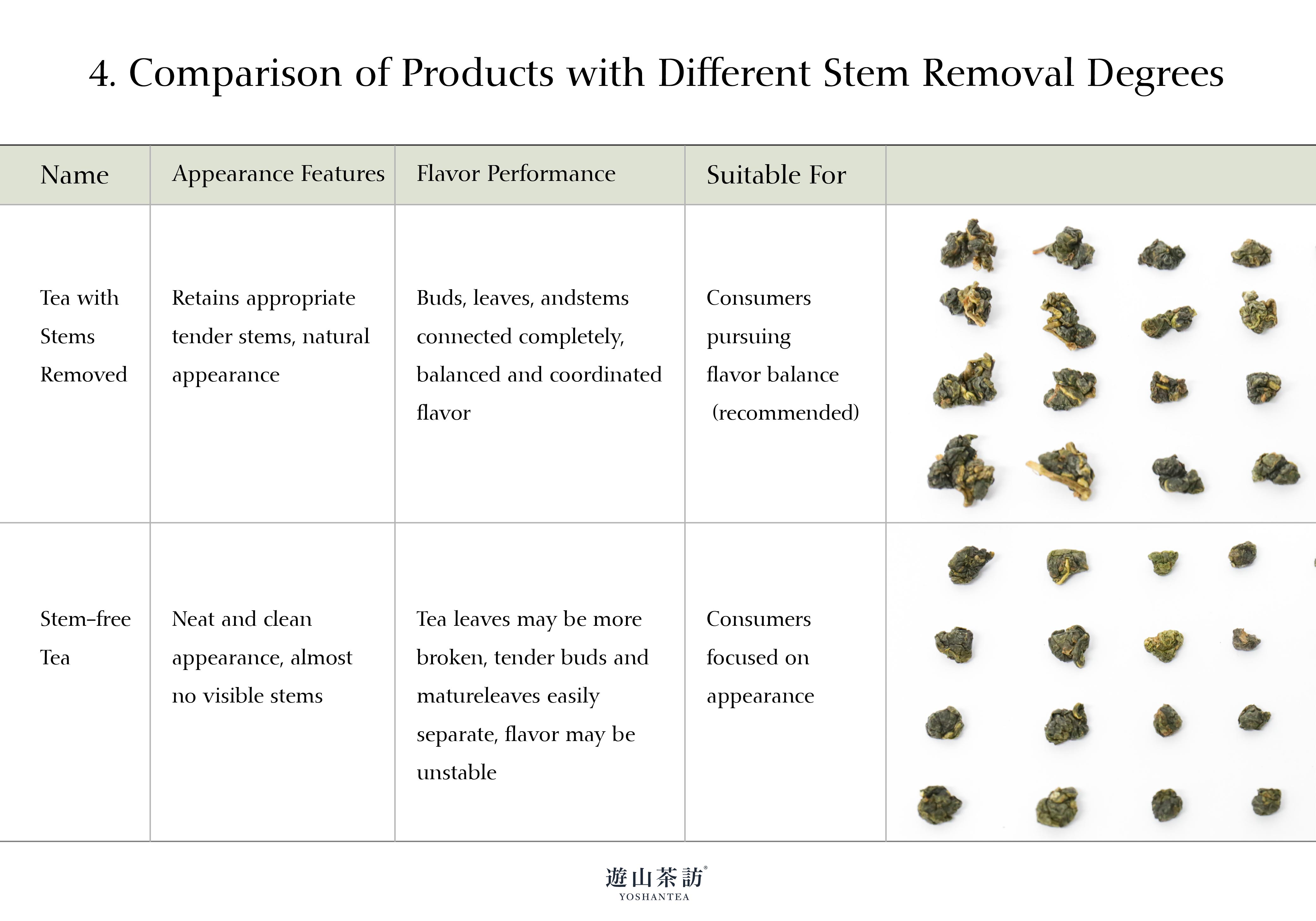
If stems are completely removed, it causes the problem of separating tender and mature parts.
As mentioned earlier, buds are more astringent but have strong aftertaste, while leaves don't have aftertaste but are sweet and aromatic.
When stems don't connect them, brewing becomes imbalanced:
- May brew only buds, resulting in overly bitter tea lacking sweet smoothness
- May brew only leaves, which though sweet and aromatic lack depth, without aftertaste charm
- Cannot obtain balanced release of buds, leaves, and stems in each brew
This is like an orchestra losing its conductor – although each instrument is good, they cannot perform harmoniously.
The presence of stems ensures each brew has complete and coordinated flavor expression.
To achieve a completely stem-free state,
tea leaves must go through meticulous screening procedures to make particle sizes consistent,
meaning making tea leaf tenderness nearly uniform.
While this can present a neat and beautiful appearance, it has the following problems:
1. High tea leaf loss: Screening process produces large amounts of fragments and powder, reducing yield
2. Increased costs: Requires more labor and equipment for refining
3. Monotonous flavor: Loses the layered feel of different parts complementing each other
4. Unstable brewing: After separating tender and mature parts, each brew's concentration and flavor are difficult to control
Additionally, due to the use of modern tea leaf compression machines (rolling machines),
during the rolling process, stems are often wrapped inside tea leaves and cannot be completely removed during processing.
These "hidden stems" often only appear after tea leaves are brewed and leaves unfold.
This is a normal phenomenon and doesn't indicate quality problems.
How Should We View Tea Stems Correctly?
As consumers, we can judge tea stems from the following perspectives:
Observing the Condition of Tea Stems
Quality Assessment of Tea Stems
- Are stems too coarse or lignified? Fresh stems should be tender branches, not coarse old "red stems"
- Is the stem color uniform and coordinated with tea leaves?
- Is the stem proportion appropriate?
About the Definition of "Red Stems"
According to CNS 179:2021 national standards, "red stems" refer to coarse old tea stems, which are what need attention in terms of quality.
Standards stipulate that red stem content in all types of tea must not exceed 8%.
It's necessary to distinguish:
- Tender Stems: Tender branches connecting buds and leaves, normal and beneficial components
- Red Stems: Coarse old lignified stems, excessive amounts affect quality
National Standards for Tea Stem Regulation
According to CNS 179:2021 Tea National Standard Article 5.3:
| Tea Type | Red Stem Content Limit |
| Non-fermented Tea (Green Tea) | 8% |
| Partially Fermented Tea (Paochong, Oolong) | 8% |
| Fully Fermented Tea (Black Tea) | 8% |
| Post-fermented Tea (Pu-erh or Dark Tea) | 8% |
Key Points:
1. Standards limit "red stems" (coarse old stems), not all stems
2. Appropriate amounts of tender stems not only don't affect quality but actually help flavor balance
3. As long as red stem content doesn't exceed 8%, it meets national standards
Tasting Tea Infusion Performance
Flavor Balance Testing
- Is the tea infusion sweet and smooth?
- Are aroma and taste balanced?
- Are there any raw, astringent, or off-flavors?
Completeness Assessment
If the tea infusion performs well, the presence of appropriate stems is actually a plus,
indicating this batch of tea retains complete picking parts, with buds, leaves,
and stems connected completely, able to present balanced flavor in each brew.
Correct Quality Concepts
Not All Stems Are Defects
- Tender stems: Provide sweetness, body, and connect buds and leaves
- Red stems (coarse old stems): Affect taste, national standards limit to below 8%
Key Points for Quality Assessment
1. Are stems tender stems or red stems (coarse old stems)
2. Does red stem content meet national standards (≤8%)
3. Is overall flavor balanced, coordinated, and delicious
4. Does tea infusion performance meet the characteristics of this tea type
Professional Advice
For average consumers, there's no need to overly worry about "seeing tea stems." What's important is:
- Observe whether stems are tender (uniform color, delicate texture)
- Taste whether tea infusion is sweet and balanced
- Confirm absence of lignified coarse old red stems
Tea that meets national standards and has good flavor is still high-quality tea even if it contains appropriate amounts of tender stems.
Conclusion
Tea stems are not defects in tea leaves but rather a natural part of tea plant growth and key to flavor balance.
Appropriate stems are like a conductor in an orchestra, connecting the freshness of buds, the sweet aroma of leaves,
and the clean sweetness of stems, allowing each brew to display complete and harmonious flavor.
From picking to processing to refining, stem handling reflects tea masters' wisdom in balancing quality and flavor.
Whether retaining appropriate stems to maintain flavor balance or carefully removing coarse old red stems to improve quality,
it's all for presenting a good cup of tea.
Next time you drink tea, why not approach tea stems with a more open mind?
Carefully observe their appearance, taste the sweetness they bring, and feel how they make tea infusion more balanced.
You might discover that tea stems also have their unique and indispensable charm.
After all, the standard for good tea isn't just neat and uniform appearance but rather harmony and balance in flavor.
Like nature's intelligent design, buds, leaves, and stems each play their role – none can be missing.
Tea Stem Quality Classificat
#yoshantea #taiwantea #dongdingtea #oolongtea #teafactory #FSSC22000 #safetea #teaknowledge #teastems #tealife #teatasting #teamaking