Hello everyone,
I'm Andy, a tea enthusiast.
Tea testing is an endless journey.
From basic pesticide residue testing, polar pesticide testing (herbicides),
heavy metal testing, microbial testing, moisture content testing,
bulk density testing, and more—each test corresponds to different risk sources and management logic.
There are numerous testing items, and it's impossible to think through all risks and achieve perfection at once.
What truly causes pressure is often not the known testing items, but those "unexpected" tests.
Today, I want to share with you about heavy metals in tea.
Food safety incidents related to heavy metals in tea are quite rare, but that doesn't mean there are no regulations for heavy metals in tea.
This time, I'll share with you the potential risks in tea: heavy metals.
What Are Heavy Metals in Tea? Which Items Are Usually Tested?
In heavy metal testing related to tea, commonly monitored items include:
- Lead (Pb)
- Cadmium (Cd)
- Arsenic (As)
- Mercury (Hg)
These elements are not unique to tea but naturally exist in soil, water, and rock formations in nature.
As a perennial crop, tea plants have root systems in long-term contact with soil, and may naturally absorb trace amounts of heavy metals.
Therefore, the issue of heavy metals in tea is essentially not simply equivalent to pollution incidents,
but rather a comprehensive result of "environmental background levels × crop characteristics × intake methods."
How Does Taiwan Regulate Heavy Metals in Tea?
Currently, Taiwan does not have specific maximum limits (mg/kg) for heavy metals in "dried tea leaves (tea material for brewing)."
The current management basis is the "Sanitation Standard for Contaminants and Toxins in Food" by the Ministry of Health and Welfare,
which primarily targets "directly consumed food types," such as beverages, ready-to-eat foods, or infant foods.
Since tea leaves are "materials for brewing and drinking" rather than direct consumption,
they are not separately listed with mg/kg upper limits in regulatory design.
In practice, Taiwan's management of heavy metals in tea focuses more on:
- Whether there are abnormal pollution sources
- Whether there is significant deviation from reasonable background values
- And whether it will cause actual intake risks for consumers
How Do Other Countries Regulate Heavy Metals in Tea? What Is Tea's Regulatory Position?
Different countries have vastly different approaches to managing heavy metals in tea.
The key is not who is stricter, but rather the management logic of regulations and how tea is positioned within regulations.
It should be specifically noted that:
"Tea" in this article refers to tea from Camellia sinensis;
The term "infusion" mentioned in the text is merely regulatory terminology describing "intake form after brewing,"
which does not change the definition of tea, nor is it equivalent to herbal tea or fruit tea.
Taking lead (Pb) as a representative example, here's a summary of major market approaches:
| Region | Regulatory Source | Regulatory Logic | Tea's Regulatory Position | Lead (Pb) Management Method |
| Taiwan | MOHW "Sanitation Standard for Contaminants and Toxins in Food" | Risk-oriented | Tea (Camellia sinensis), managed as brewing material | No mg/kg limit for dried tea, focuses on actual intake risk |
| South Korea | MFDS "Korea Food Code" | Type-specific | Tea (Camellia sinensis), assessed as leached tea (brewed tea infusion) | ≤ 5.0 mg/kg (leached tea, condition: hot water extraction followed by filtration) |
| Mainland China | GB 2762 "National Food Safety Standard - Maximum Levels of Contaminants in Foods" | Item-specific | Tea leaves (dried tea) | ≤ 5.0 mg/kg (based on dried tea) |
| EU | Regulation (EU) 2023/915 | Intake-oriented | Tea (Camellia sinensis), risk assessed through "intake form after brewing (infusion, referring to tea liquor)" | Focused on beverage intake amount |
| Japan | MAFF/MHLW (Food Sanitation Law system and monitoring data) | Monitoring-oriented | Tea (Camellia sinensis), assessed by extraction into brewed tea and intake amount | No mg/kg limit for dried tea |
| USA | California Proposition 65 (OEHHA Safe Harbor Levels) | Exposure and information disclosure-oriented | Tea (Camellia sinensis), assessed by daily exposure in actual drinking scenarios | Determined by µg/day whether warning is required |
Notes:
- Leached tea refers to brewed tea infusion (extracted liquid), not dried tea leaves. The extraction condition in Korean regulations is: hot water extraction followed by filtration.
- California Proposition 65 is a warning system, not a standard for food compliance/non-compliance.
Why Is It Difficult to Regulate Heavy Metals in Tea?
Tea plants are perennial crops that grow in fixed locations and are mostly distributed in acidic soils and hilly terrains.
In some tea regions, certain heavy metals naturally have higher background values, not caused by human pollution.
This is also why China encountered practical difficulties when attempting to establish comprehensive heavy metal limits for tea in the early days. More precisely:
China did not completely abolish heavy metal standards for tea,
but rather adjusted its management strategy due to soil background values and controllability issues,
ultimately retaining key items such as lead (Pb) while abandoning limits on some metals that were too idealistic and difficult to implement.
The Most Easily Misunderstood Aspects of Tea Heavy Metal Regulations
In practice and communication, the most common misunderstanding is:
The term "tea" is often directly conflated with regulations for herbal tea, fruit tea, and ready-to-drink tea beverages.
But in fact:
- Tea leaves are made from Camellia sinensis
- Herbal teas are mostly dried products from other plants
- Ready-to-drink tea is a liquid product for direct consumption
The regulatory positioning and risk assessment methods for these three categories should not be mixed.
When searching for regulations, it's also necessary to pay special attention to whether keywords accurately point to tea from tea plants, such as:
Camellia sinensis, dry tea leaves, loose-leaf tea, leached tea, brewed tea, to avoid incorrectly applying standards from unrelated categories to tea.
Actual Extraction of Heavy Metals in Tea Infusion
The heavy metal content detected in dried tea does not equal the actual intake amount when drinking.
Taking lead (Pb) as an example, research shows that under normal brewing conditions,
the extraction rate of lead is approximately 5-20%. In other words, even if 0.1 mg/kg of lead is detected in dried tea,
the amount actually entering the tea infusion may only be 0.005-0.02 mg/kg.
Factors affecting heavy metal extraction include:
- Brewing temperature: Higher temperature slightly increases extraction
- Brewing time: Long soaking increases extraction
- Tea-to-water ratio: Higher concentration increases total extraction
- Water pH: Acidic water may slightly increase extraction
This is also why most countries use "intake amount after brewing" rather than "dried tea content"
as the judgment basis when assessing heavy metal risks in tea.
Where Do Heavy Metals in Tea Come From?
Natural Background Sources
- Soil parent rock: Some geological structures naturally contain higher heavy metals
- Volcanic ash soil: Some tea regions' soil naturally contains higher arsenic or lead
- Acidic soil: Tea plants prefer pH 4.5-6.0 soil, which may increase metal activity
Anthropogenic Pollution Sources
- Industrial emissions: Air deposition from nearby factories or mining areas
- Sewage irrigation: Using untreated industrial wastewater for irrigation
- Waste pollution: Electronic waste or battery pollution around agricultural land
- Improper fertilization: Some inferior fertilizers may contain heavy metal impurities
Processing Sources
- Mechanical wear: Old metal equipment may release lead or cadmium
- Packaging materials: Non-compliant metal cans or printing inks
- Drying equipment: Coal-fired drying may introduce heavy metals
What Is the Heavy Metal Content in Taiwan Tea Testing?
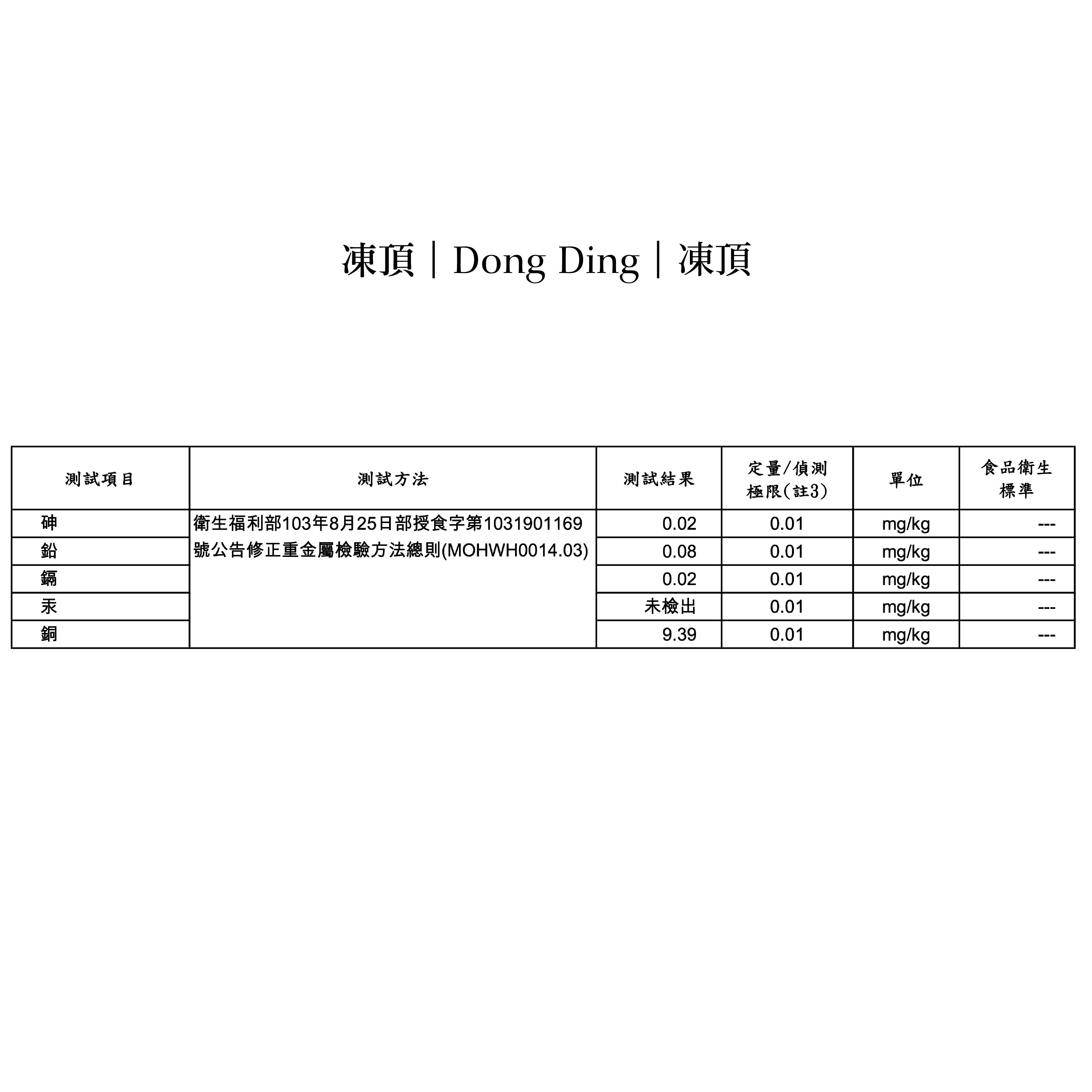
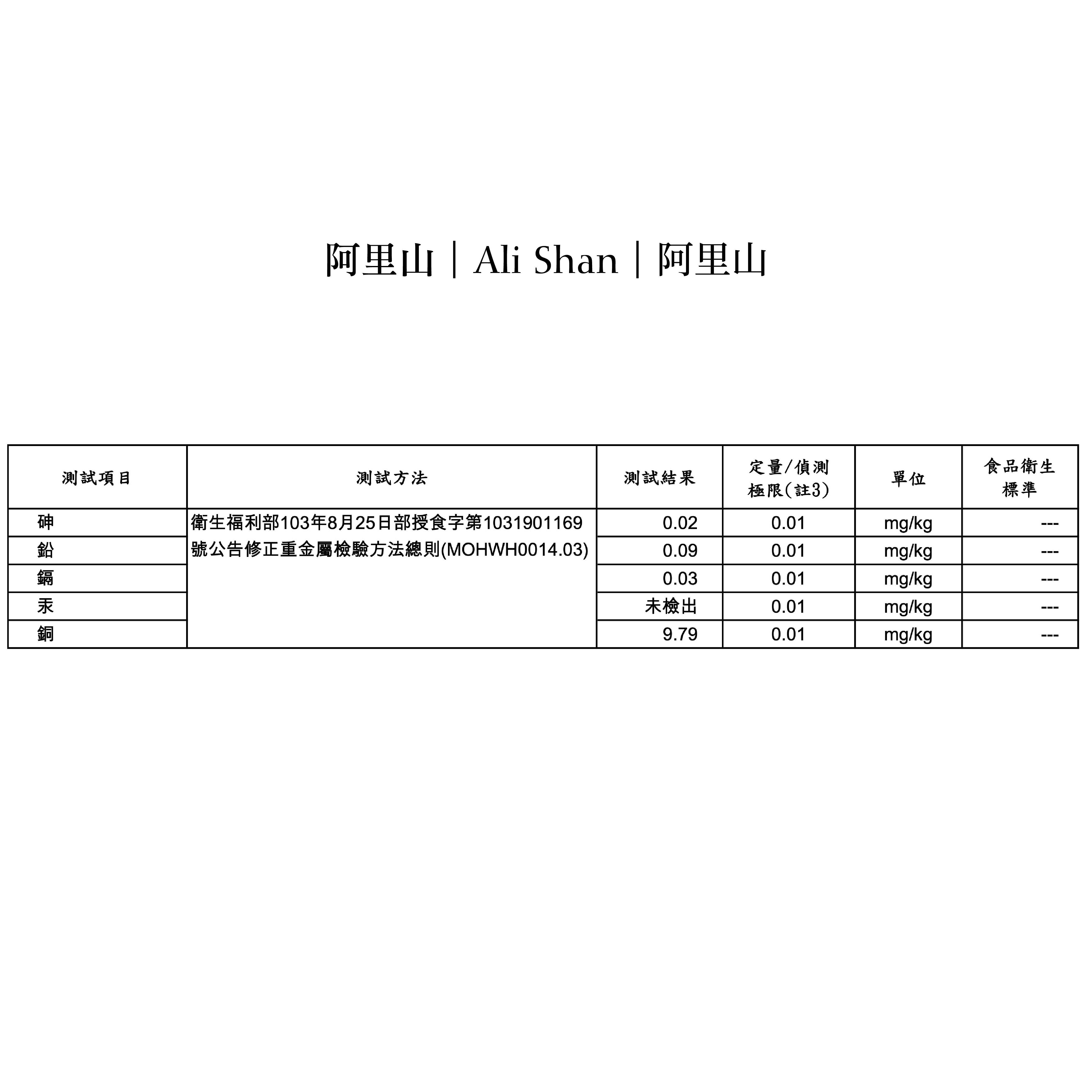
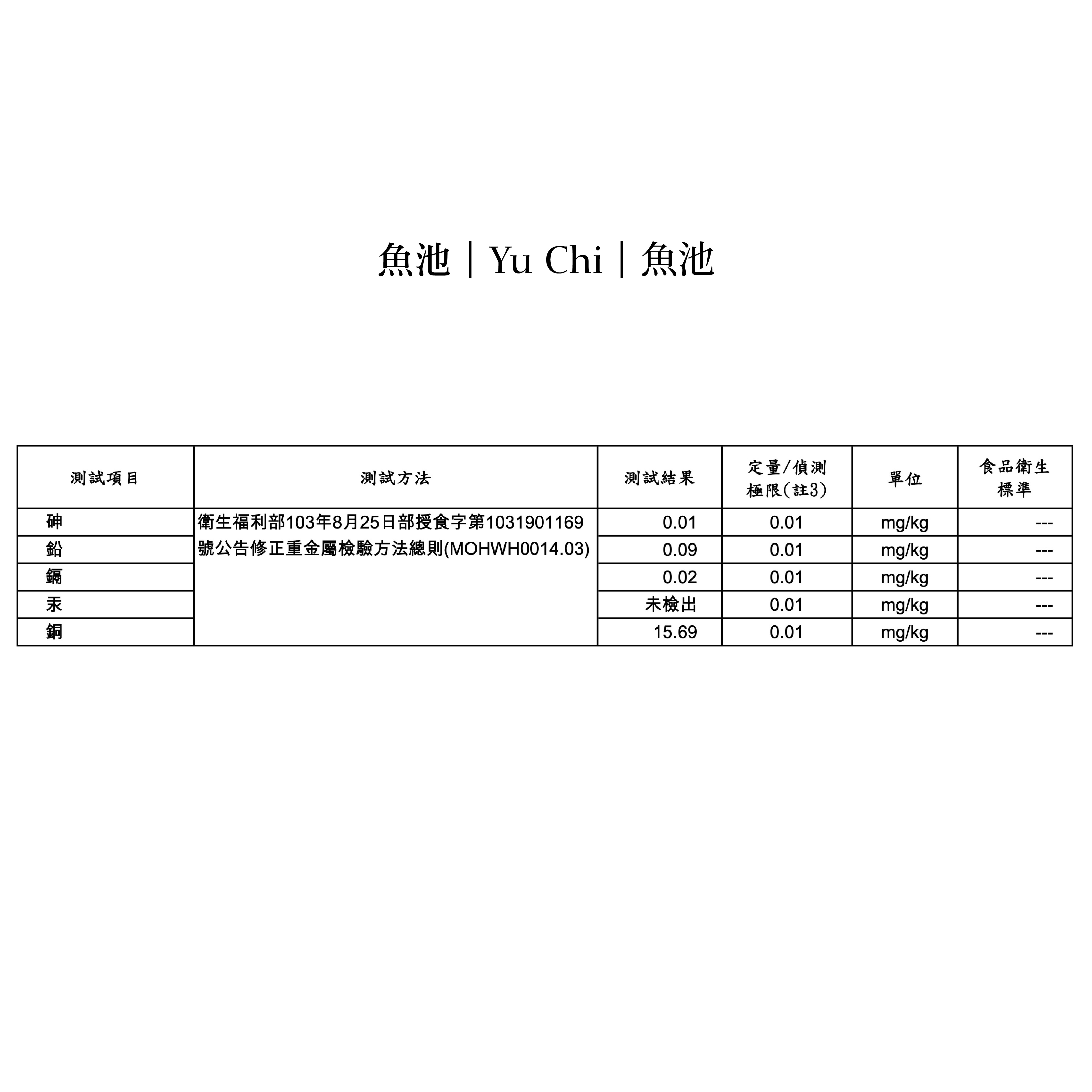
Using Dong Ding, Ali Shan, and Yu Chi as Examples
From actual testing data, the heavy metal content in Taiwan tea is overall low and stable.
According to SGS test reports,
in dried tea from three representative production areas—Dong Ding Oolong Tea, Ali Shan Oolong Tea,
and Yu Chi Black Tea—lead (Pb) is approximately 0.08–0.09 mg/kg, cadmium (Cd) approximately 0.02–0.03 mg/kg,
arsenic (As) approximately 0.01–0.02 mg/kg, and mercury (Hg) is not detected.
It should be specifically noted that these results are "total content in ground dried tea,"
not the actual intake amount in brewed tea infusion; under normal brewing conditions,
the amount of heavy metals actually entering the tea infusion is usually significantly lower.
Conclusion
Considering the regulatory positioning, management logic,
and actual testing data from various countries, heavy metals in tea are not an issue requiring excessive panic.
Taking the actual measurement results from Taiwan's main tea regions as an example,
whether Dong Ding, Ali Shan,
or Yu Chi, the heavy metal content in tea is far below the threshold of concern in most international regulations,
and under normal brewing conditions, the intake amount actually entering the tea infusion is further reduced.
From a comprehensive judgment of scientific, regulatory, and actual drinking risk perspectives,
Taiwan tea that complies with good management and testing mechanisms can be consumed with confidence under normal drinking circumstances.
I hope this information is helpful to everyone.
See you next time!
#yoshantea #taiwantea #dongdingtea #oolongtea #teafactory #FSSC22000 #safetea #heavymetals #foodsafety #teatesting