Hello everyone,
I'm Tea Enthusiast Andy.
Compliance with pesticide residue regulations is the very first checkpoint in tea quality management.
A complete pesticide residue test report contains a wealth of information, but many people feel overwhelmed when they see pages filled with numbers and chemical names.
Today I'd like to share how to read and understand a tea pesticide residue test report.
How Are Pesticide Residues in Tea Tested?
There are two main categories of pesticide residue screening methods in common use.
Rapid Screening Method (Enzyme Inhibition Method)
The principle is based on the ability of certain pesticides to inhibit acetylcholinesterase activity, which serves as an indicator of residue presence.
In the early days, the enzyme was extracted from fly heads, because fly heads are rich in acetylcholinesterase with high extraction efficiency.
Modern labs now use commercially purified enzyme reagents instead.
The rapid method is fast and inexpensive, making it useful for on-site preliminary screening.
However, it only detects organophosphate and carbamate pesticides,with sensitivity in the range of approximately 0.1 to 1 ppm.
Its accuracy is far below that of laboratory methods, so results are for reference only and cannot serve as formal compliance evidence.
For a deeper look at the enzyme inhibition method, refer to this article:
https://www.intelligentagri.com.tw/xmdoc/cont?xsmsid=0M068492401417538149&sid=0N275556516249181280
Official Laboratory Testing Methods
This involves sending samples to accredited laboratories (such as SGS or Eurofins) for analysis using government-approved standard methods.
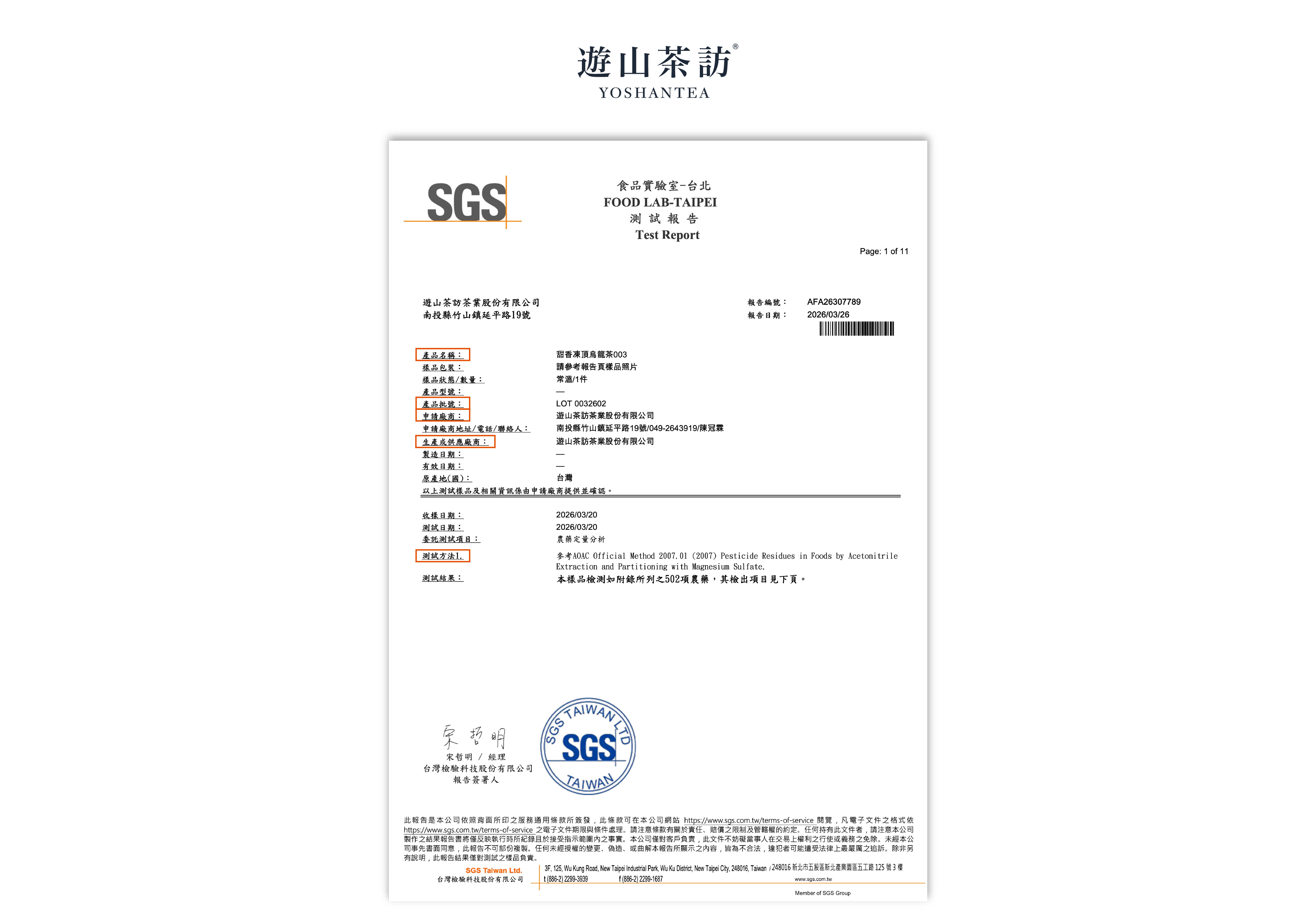
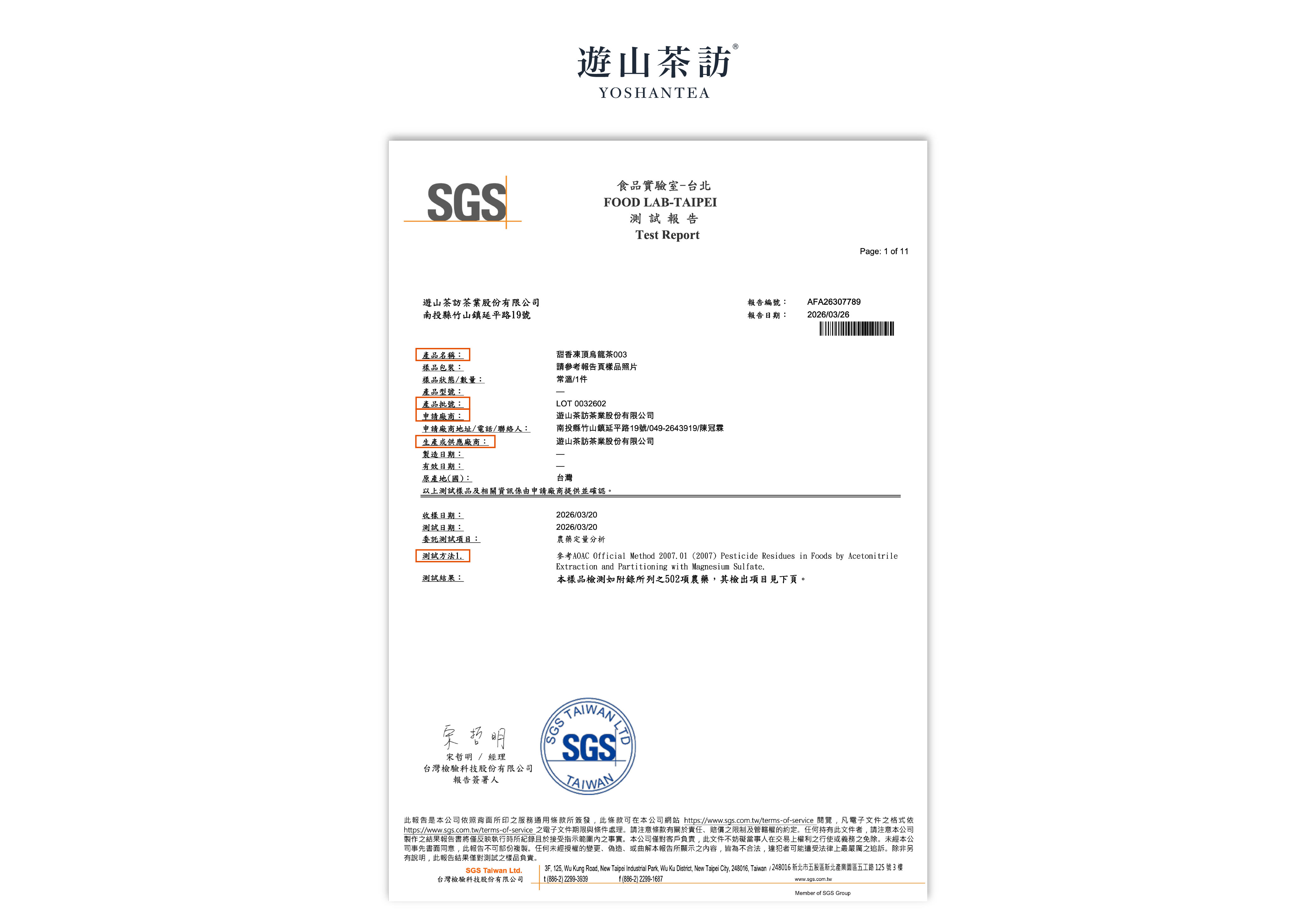
In this report, the method used is AOAC Official Method 2007.01 (2007), which uses acetonitrile extraction and magnesium sulfate partitioning for multi-residue analysis.
This particular test covers 502 pesticides.
Can You Taste Pesticide Residues?
Almost certainly not.
Pesticide residue concentrations are typically in the ppm (parts per million) or even ppb (parts per billion) range, far below the threshold of human taste perception.
Relying on taste to judge pesticide safety is simply not reliable.
What Does a Pesticide Residue Report Tell You?
Using this SGS report as an example, here are the key fields to understand.
Product Name and Lot Number
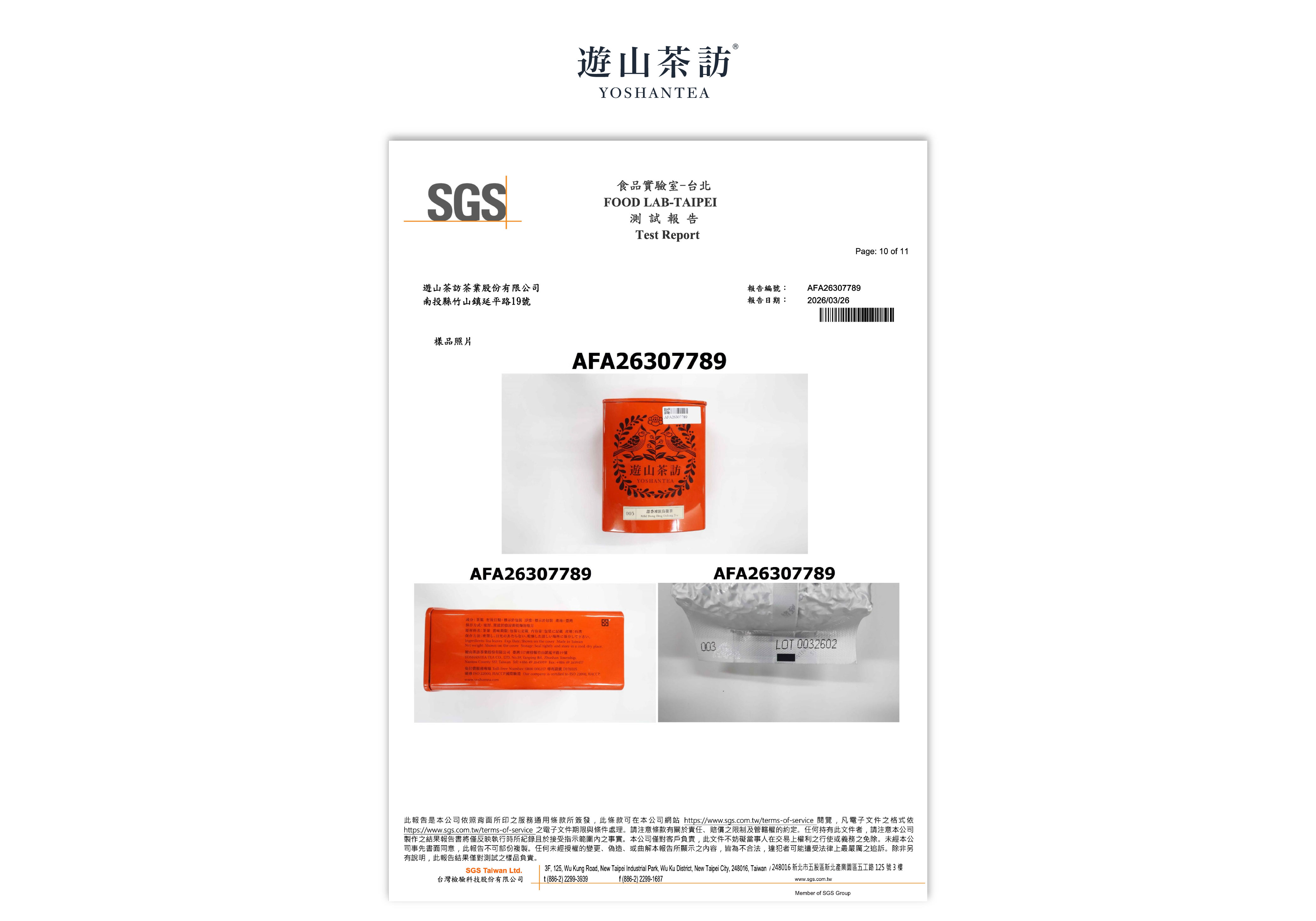
Sweet-Aroma Dong Ding Oolong Tea 003, Lot No. LOT 0032602, clearly linked to a specific production batch for traceability.
If a problem arises, the lot number allows the issue to be contained quickly.
Applicant and Producer
This report was commissioned by YOSHANTEA TEA CO., LTD., with the same company listed as producer,
meaning this is voluntary self-testing rather than government inspection.
Voluntary testing reflects a proactive approach to quality management rather than waiting to be audited.
Test Method
AOAC 2007.01 covers multi-residue analysis for a broad range of pesticides, but it has scope limitations.
Different methods cover different pesticide categories, which will be discussed further below.
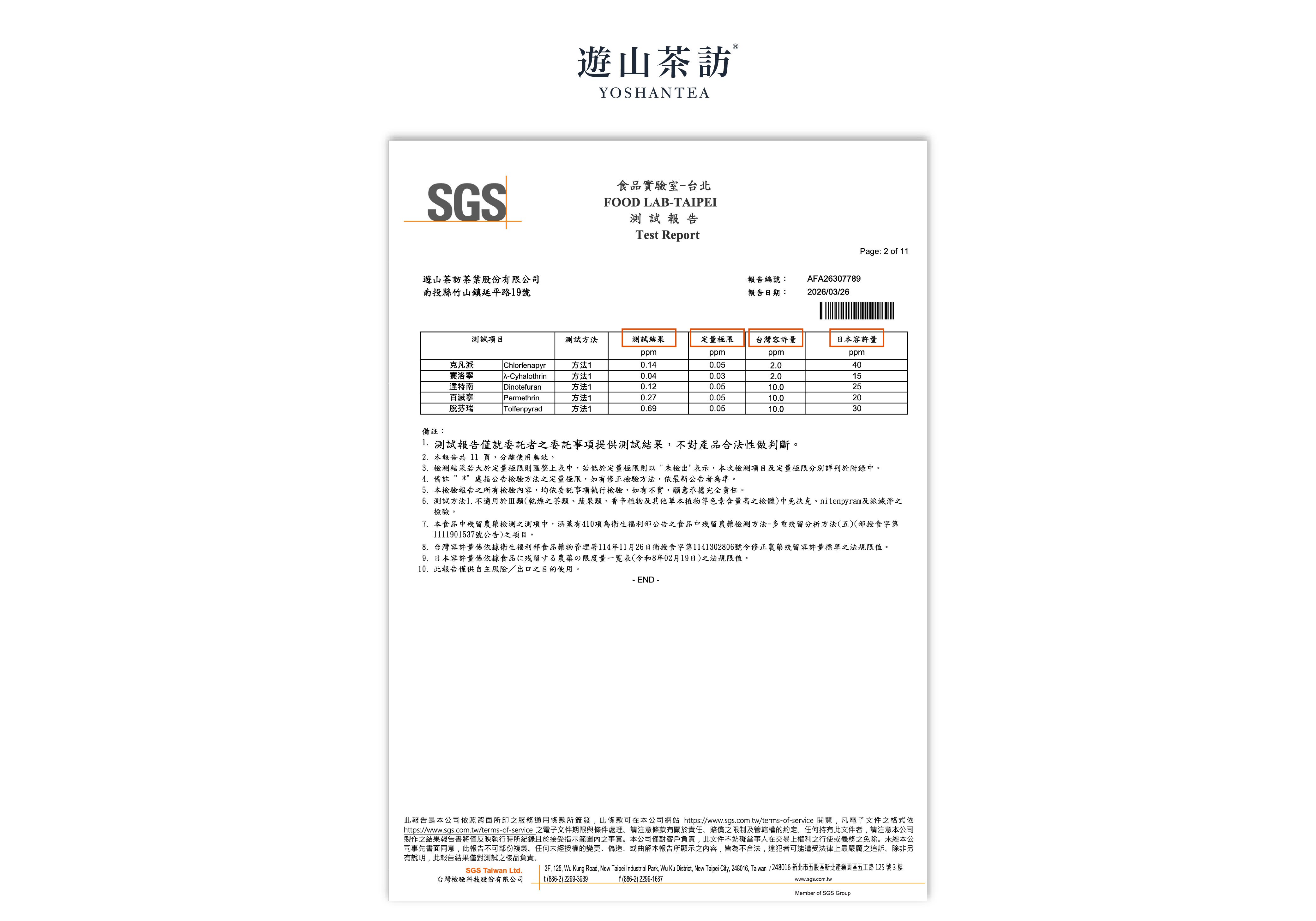
Test Results (Page 2)
A total of 5 pesticides were detected in this test.
Detection does not mean non-compliance. As long as values fall below the legal maximum residue level (MRL), the product is compliant.
The report itself does not make a legal judgment.
Limit of Quantification (LOQ)
This is the most overlooked field in the report.
Using Chlorfenapyr as an example, the LOQ is 0.05 ppm.
This means the value only appears in the report if the residue reaches 0.05 ppm or above.
Below this threshold, the report states "not detected," but this does not mean zero.
It simply means the residue is below the instrument's reliable detection limit.
Taiwan MRL and Japan MRL
The report lists permitted levels for both countries, which is useful for export compliance review.
Note that MRLs for the same pesticide can differ significantly between countries.
A value that is compliant in Taiwan may not meet Japanese or EU standards.
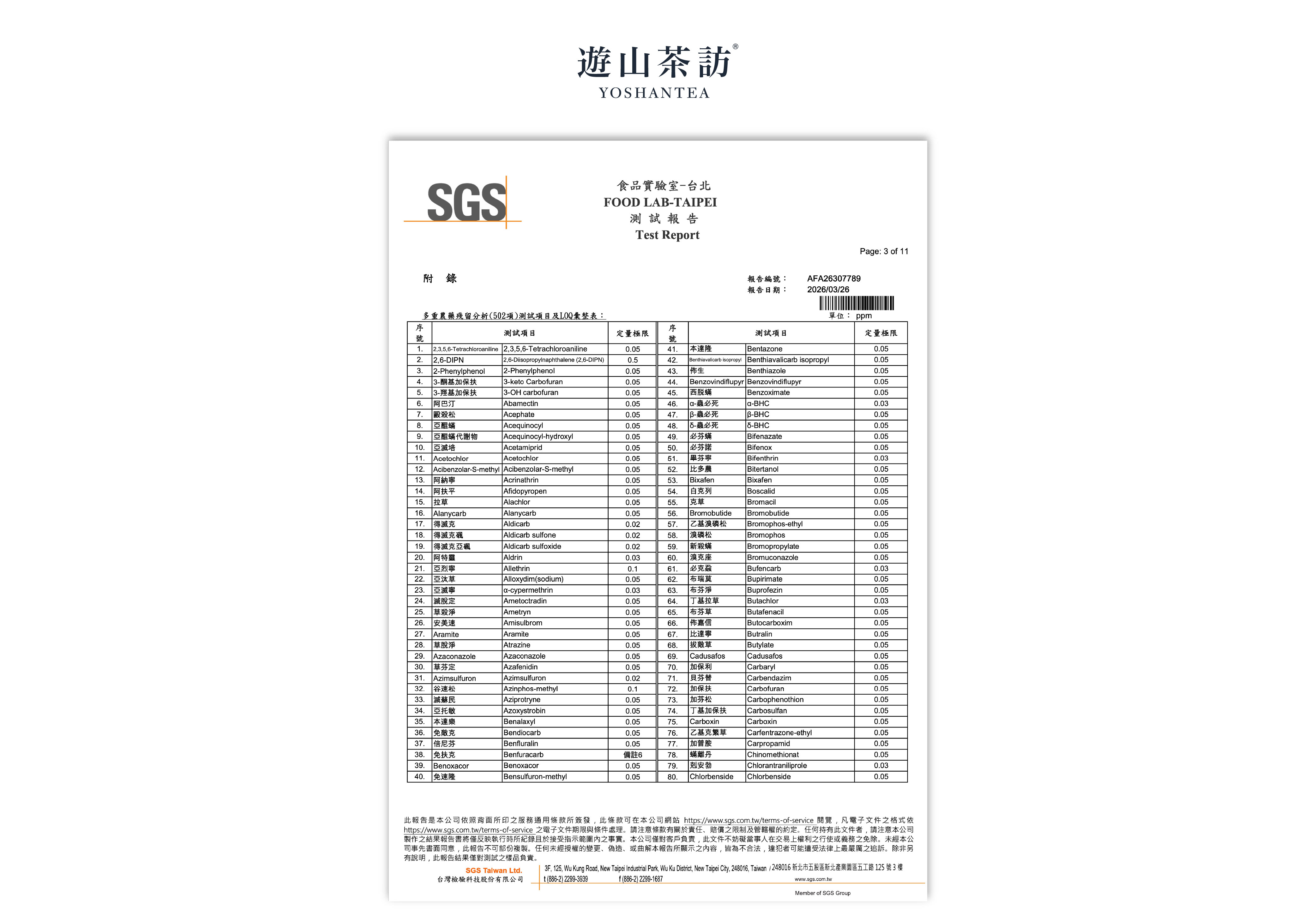
Appendix (From Page 3 Onward)
The appendix lists all 502 pesticides that were included in the test scope, along with each one's LOQ.
This section does not show what was detected. It shows what was tested for.
Pesticides in the appendix that do not appear in the page 2 results table simply fell below the LOQ, not that they are definitively absent.
Key Takeaways for Reading Reports
When reviewing a pesticide residue report: first confirm the lot number and test date to ensure it matches the correct batch;
next check the test method to understand which pesticides are covered;
then review the results section with an understanding of what "not detected" actually means;
finally compare against the MRLs of your target export market, not just Taiwan's standards.
How to Verify That a Laboratory Is Competent?
The most important step in evaluating the credibility of a test report is confirming that the issuing laboratory holds ISO/IEC 17025 accreditation.
ISO/IEC 17025 is the international standard for testing and calibration laboratory competence.
Accreditation means that the laboratory's methods, equipment, personnel, and data quality have been independently verified by a third-party body.
In Taiwan, the accreditation body is the Taiwan Accreditation Foundation (TAF).
You can search for a laboratory's accredited scope at the following link to confirm that the test method used is within their accredited capabilities:
https://accreditation.taftw.org.tw/taf/public/basic/viewApplyItems.action?unitNo=0860
Note that the TAF accreditation mark may not appear on every report. It is recommended to check the TAF website directly or request the accreditation certificate from the laboratory.
Does Passing the Residue Test Mean the Entire Batch Is Safe?
Not necessarily. There are several important points to keep in mind.
Sampling Variability
Tea batches are often blended from multiple sources. If blending is uneven, the sample submitted for testing may not accurately represent the full batch.
The result for one sample cannot guarantee the status of the entire lot.
"Not Detected" Does Not Mean Zero
The report only lists values that exceed the LOQ.
Using Chlorfenapyr (LOQ = 0.05 ppm) as an example, if the actual residue is 0.04 ppm, it will not appear in the report, but the residue is still present.
Values Close to the MRL Carry Higher Risk
If Taiwan's MRL for a pesticide is 0.05 ppm and the test result is 0.048 ppm, the product passes, but only by a very small margin.
In a large, unevenly blended batch, a different sampling point could yield a non-compliant result.
In such cases, increasing the number of tests or expanding sampling points helps reduce this risk.
Quartering is a practical sampling technique to improve representativeness. See this video for a demonstration:
https://youtu.be/aHS-MaBoLok?si=KZ4Plf3D0qc1sqkc&t=166
Hundreds of Pesticides Are Listed. What Else Should I Know?
AOAC 2007.01 covers a broad range of pesticides, but it has a well-known blind spot: polar pesticides.
Polar pesticides are highly water-soluble compounds that move easily with water.
Common examples include Glyphosate (sold as Roundup, with metabolite AMPA) and Glufosinate (with metabolite MPPA).
Because these compounds have very different chemical properties from conventional pesticides,
the acetonitrile-based extraction in AOAC 2007.01 cannot recover them effectively, making the results unreliable for these substances.
So when polar pesticides do not appear in a report, it does not mean they are absent. It means they were not tested for at all.
To check for polar pesticides, samples must be submitted to a laboratory using a dedicated method.
The current standard for polar pesticide analysis is the QuPPe-PO Method (Quick Polar Pesticides Method for Plant Origin, V12.1, 2023),
which uses acidified methanol extraction combined with LC/MS/MS detection.
Conclusion
Tea pesticide residue testing is a form of sampling verification, not a comprehensive guarantee.
A passing result means the tested sample complied with current regulations at the time of testing. It does not guarantee that every unit in the batch is problem-free.
A few principles worth remembering: good voluntary testing should be backed by a sound sampling plan; results close to the MRL deserve extra attention;
and the scope of the test method determines the boundaries of what the report can actually tell you.
For export purposes, always compare against the MRLs of your target market, as the same pesticide can have very different limits in different countries.
Related Pesticide Knowledge
I hope this article has been helpful.
See you next time.
#yoshantea #taiwantea #dongdingtea #oolongtea #teafactory #FSSC22000 #safetea #pesticideresidues #teatesting #foodsafety #ISO17025 #teaknowledge