Hello everyone,
I'm Andy, a tea enthusiast.
With Trump's latest tariff policy making headlines,
many people have been worried about whether tea exports will be affected.
The good news is that tea remains tariff-free. Here's a summary of this latest policy.
What is this new tariff?
On February 20, 2026,
President Trump signed a Presidential Proclamation imposing an additional 10% ad valorem duty on nearly all goods imported into the United States.
The measure took effect on February
24, 2026 at 12:01 a.m. Eastern Standard Time, and will remain in effect for 150 days, through July 24, 2026.
The legal authority for this action is Section 122 of the Trade Act of 1974,a relatively rarely invoked provision,
distinct from the Section 232 (national security) and Section 301 (unfair trade practices) authorities Trump has used previously.
Section 122 empowers the President to impose temporary import restrictions when the United States faces fundamental international payments problems.
The White House Proclamation cited the following data:
the U.S. goods trade deficit reached $1.2 trillion in 2024; the current account deficit stood at 4.0% of GDP,
the largest since 2008; and the U.S. net international investment position was negative 90% of GDP,
the most negative of any major economy.
These figures form the legal basis for invoking Section 122.
Is tea subject to this additional tariff?
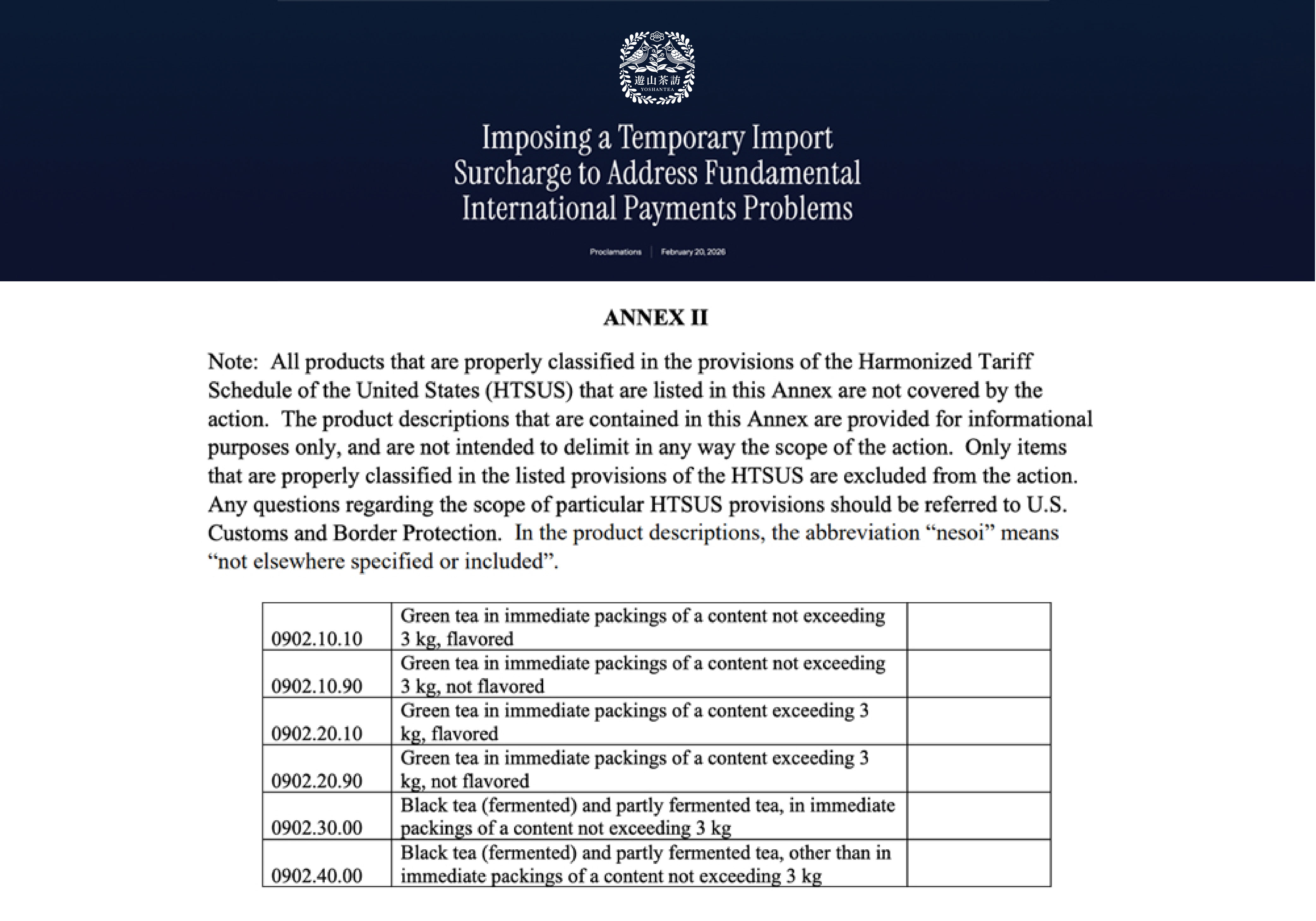
No. Tea is explicitly listed on the exemption list.
Annex I and Annex II of the Proclamation provide a detailed list of all exempted goods by HTSUS
(Harmonized Tariff Schedule of the United States) subheading. All tea subheadings are included:
| HTSUS Subheading | Description |
| 0902.10.10 / 0902.10.90 | Green tea, in immediate packings ≤3 kg |
| 0902.20.10 / 0902.20.90 | Green tea, in packings >3 kg |
| 0902.30.00 | Black tea and partly fermented tea (incl. oolong), packings ≤3 kg |
| 0902.40.00 | Black tea and partly fermented tea (incl. oolong), other packings |
This means that Taiwan's key export teas,
including oolong, black tea, and green tea, are completely unaffected by this 10% surcharge.
The exemption rationale falls under "agricultural raw materials that cannot be grown or produced in sufficient quantities in the United States," placing tea in the same category as coffee and cocoa.
This is consistent with last year's reciprocal tariff exemption, reflecting tea's stable position in the U.S. agricultural import system.
Are there any points to watch even with the exemption?
1. The exemption has an expiration date
The current exemption runs through July 24, 2026.
If Congress does not extend it and no new announcement is made,
the entire tariff structure will be subject to revision.
2. Country of origin matters more than tariff rates
Even with the exemption, the primary focus of U.S. Customs and Border Protection (CBP) is country of origin.
Tea is an agricultural product generally treated as
"wholly obtained," meaning the place of harvest equals the country of origin.
This is an advantage for Taiwanese tea.
However, if tea is transshipped through a third country,
CBP may require proof of origin, including harvest documentation,processing records,
factory information, and raw material traceability.
Without this documentation, even duty-free goods may face extended inspection, additional duties, or return shipment.
3. The USTR Section 301 investigation has been launched
The same White House announcement noted that Trump has directed the U.S. Trade Representative (USTR) to open a Section 301 investigation into unreasonable or discriminatory trade acts, policies,
and practices. If Taiwan is brought within the scope of this investigation, a separate wave of tariffs,
independent of the current exemptions, may follow and should be monitored closely.
In summary, tea has now been excluded from U.S. tariff increases for the second consecutive time,
which is a very positive signal for Taiwan's tea industry.
But exemption from tariffs is not exemption from compliance.
Transparent origin documentation, complete supply chain records,
and ongoing monitoring of trade policy changes are the true foundation for Taiwan tea's resilience in international markets.
I hope this article has been helpful.
See you next time.
Official Sources
Presidential Proclamation: https://www.whitehouse.gov/presidential-actions/2026/02/imposing-a-temporary-import-surcharge-to-address-fundamental-international-payments-problems/
White House Fact Sheet: https://www.whitehouse.gov/fact-sheets/2026/02/fact-sheet-president-donald-j-trump-imposes-a-temporary-import-duty-to-address-fundamental-international-payments-problems/
#yoshantea #taiwantea #dongdingtea #oolongtea #teafactory #FSSC22000 #safetea #teaexport #ustariff #trumptariff #section122 #tariffexemption #ruleoforigin #internationaltrade #tradecompliance