Hello everyone,
I'm Andy, a tea enthusiast.
Tea lovers who buy tea often notice that tea packed in vacuum sealed foil bags looks like it's higher quality.
When tea isn't vacuum sealed, something can feel a little off, as if the quality isn't as good.
But actually, tea doesn't always need to be vacuum sealed for storage.
This time, let's talk about why some teas need to be vacuum sealed, and why some don't.
Why does tea need to be vacuum sealed?
The main factors that cause tea quality to deteriorate are light, oxygen, and temperature.
Vacuum sealing mainly addresses the oxygen problem, removing the air inside the package to minimize the tea's exposure to oxygen.
Oxygen causes the compounds in tea to oxidize, which leads to a decline in aroma and changes in the liquor's color.
That said, vacuum sealing doesn't remove oxygen completely.
Trace amounts of oxygen still remain in the package, so for extra protection, an oxygen absorber can be added.
Also, for strip shaped teas, the vacuum should not be pulled too forcefully, or the tea leaves can break during the process.
What happens if tea isn't vacuum sealed?
If tea isn't vacuum sealed, air remains in the package, and the tea continues to be exposed to oxygen.
This naturally speeds up oxidation, making quality deterioration more noticeable.
The aroma changes more quickly, and over time, the tea may even develop a rancid, oily smell.
Taiwan's climate tends to be humid, so tea that isn't vacuum sealed is also more prone to absorbing moisture, which further affects its quality.
Is vacuum sealing really better?
Many people assume vacuum sealing always means better quality, but that's not necessarily true.
It depends on the tea's fermentation level and roasting level.
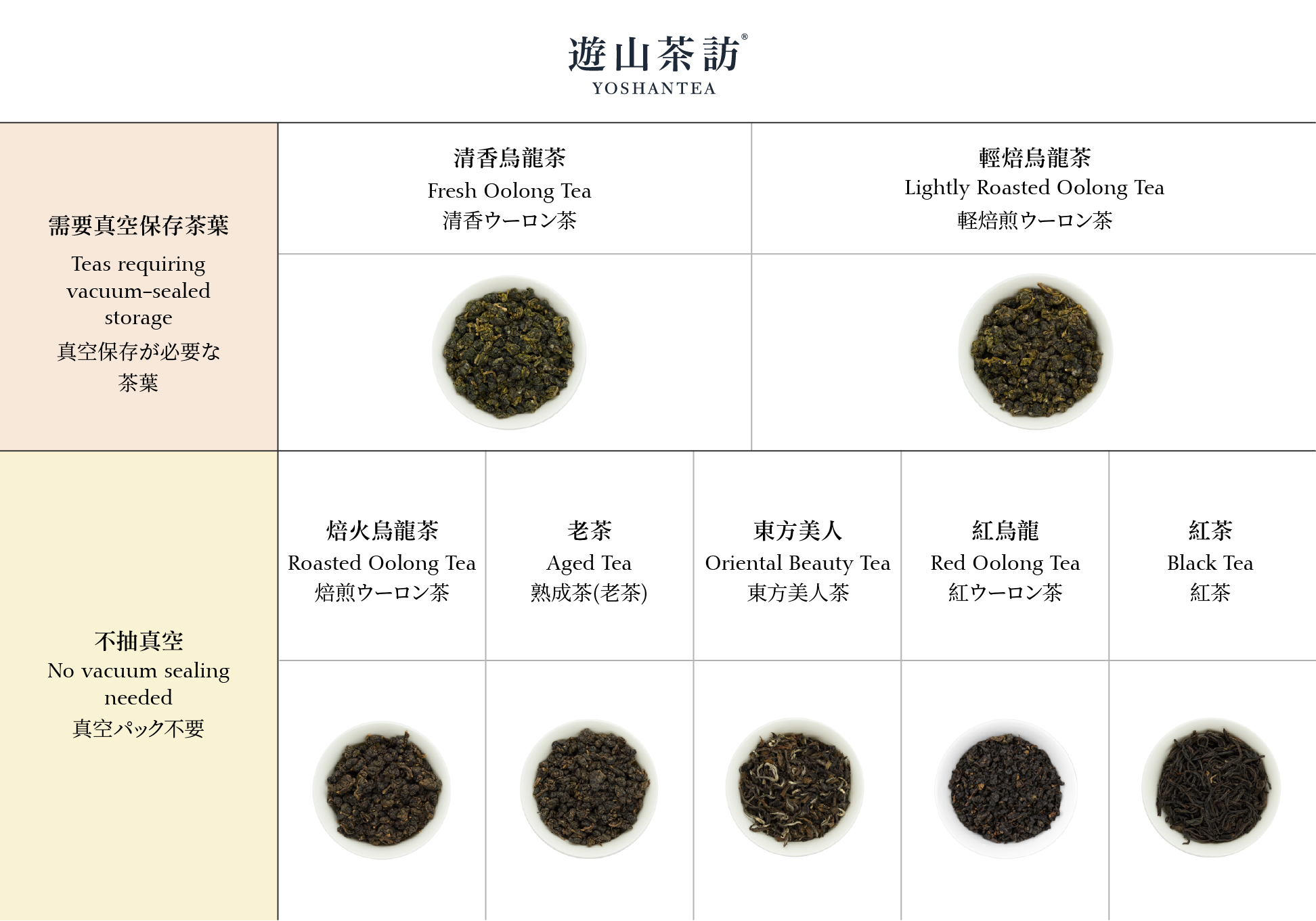
For lightly fermented, unroasted teas, such as fragrant style oolong, vacuum sealing effectively preserves fresh aroma and prevents oxidation related deterioration.
But for teas with higher oxidation levels or that have been roasted, the opposite is true.
Not vacuum sealing actually benefits quality.
During roasting, most of the compounds prone to spoilage have already been transformed or removed,
and these teas actually benefit from some exposure to oxygen, which allows their flavor to continue developing and maturing.
This is also why some aged teas and roasted teas are known for tasting better with time. Sealing them in a vacuum would limit this natural flavor development,
and over time the flavor profile can become flatter,making it harder to bring out the layered complexity of the roast. So vacuum sealing isn't automatically a plus.
The right storage method depends on the specific characteristics of the tea.
Which teas don't need to be vacuum sealed?
Based on the principles above, the teas that don't need to be vacuum sealed are mainly those with heavier fermentation or that have been roasted,
such as Red Oolong, Oriental Beauty, and Black Tea, as well as teas that have gone through roasting, and aged teas.
These teas have already undergone more complete oxidation or roasting during processing, so their properties are relatively stable,
and some exposure to air actually helps their flavor mature. To store these teas, simply keep them in a cool, dry, light protected place, in a well sealed container or bag.
Vacuum sealing isn't necessary.
Hope this has been helpful. See you next time.
#yoshantea #taiwantea #dongdingtea #oolongtea #teafactory #FSSC22000 #safetea #teaknowledge #vacuumsealed #teapreservation #roastedoolong #agedtea