Hello everyone!
I'm Andy, a tea enthusiast.
Ever since I was a child, I have heard people say, "Tea that has seen the sun simply smells better.
" The saying has been around for a long time, and many people firmly believe it.
This year I came across a study that takes this idea apart using laboratory instruments and sensory evaluation,
and its findings can be compared with how oolong tea is actually produced in Taiwan.
The Short Answer
Solar withering does bring out the most pronounced floral and honey notes.
But whether a tea is aromatic may depend not only on whether the leaves saw the sun,
but also on how well the withering is managed: how much water the leaves lose, and how quickly they lose it.
Handled well, indoor withering alone can produce tea that scores just as highly,
although its aroma has a somewhat different character.
What Does Withering Do?
Withering is the first step in making oolong tea.
Freshly plucked leaves are spread out so that moisture slowly evaporates and the leaves soften.
This is also when chemical changes inside the leaf begin.
The study separates two ideas that are often lumped together:
- Dehydration ratio: how much water is lost in total, in other words the "amount."
- Dehydration rate: how much water is lost per hour, in other words the "speed."
How the Study Was Done
The paper was published in 2026 in npj Science of Food by a team from South China Agricultural University.
It studied Lingtou Dancong from Guangdong. Dancong is rarely seen in Taiwan,
but like Taiwan's high mountain tea, Dong Ding Oolong and Wenshan Bao Zhong Tea,
it is an oolong tea, and solar withering is likewise the most critical step in making it.
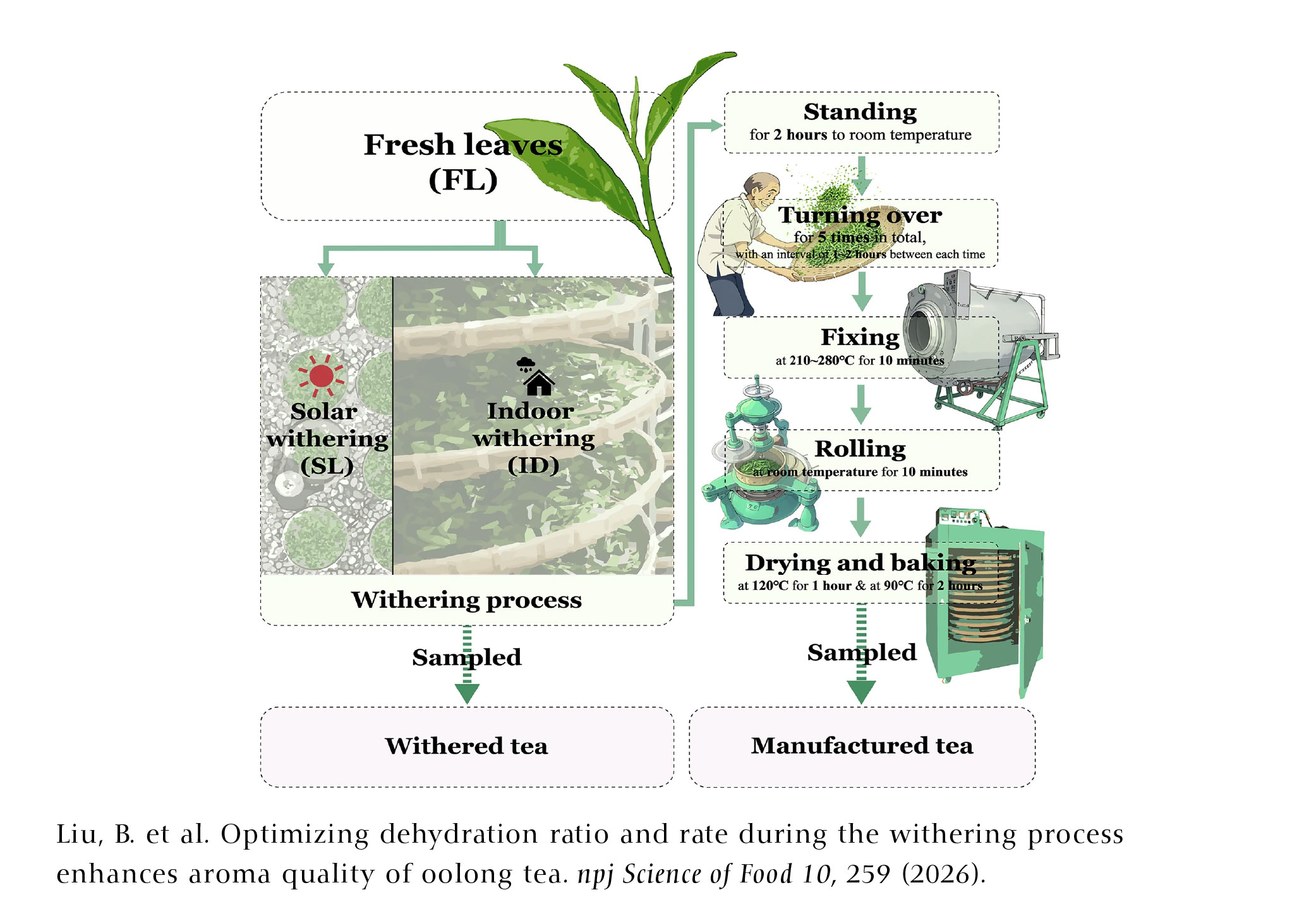
The researchers divided a single batch of fresh leaves into several groups:
- Solar withering: 10% water loss in 36 minutes.
- Indoor withering for the same 36 minutes: only 1.3% water loss.
- Indoor withering extended until 10% water loss: nearly 5 hours.
- Indoor withering with forced airflow: about 3 hours to reach 10% water loss.
After withering, tea masters processed the leaves into finished tea. The aroma compounds were analyzed by gas
chromatography–mass spectrometry (GC-MS), and a sensory panel scored the teas.
Finding 1: Enough Water Loss Clears the Raw Green Note
Fresh tea leaves contain a grassy-smelling compound called (E)-2-hexenal.
In the group that lost only 1.3% of its water, it was still abundant.
But once water loss reached 10%, whether in sunlight or indoors, it became almost undetectable.
Where did it go? It was converted into alcohols and esters, such as hexenol,
which has a fresh character, and (Z)-3-hexenyl acetate, which has fruity, clean notes.
This also explains why tea withered indoors on rainy days is often described as tasting raw and green.
In many cases the problem is not the weather itself, but that the leaves have not lost enough water.
Finding 2: Fast Enough Water Loss Lifts the Floral Aroma
With the same 10% water loss, the faster group with airflow contained more than twice as much nerolidol,
a compound with a jasmine-like floral scent, as the group left to dry slowly.
Other floral compounds such as linalool and indole were also higher.
The authors suggest that rapid water loss acts as a kind of stress on the leaf.
The leaf switches on its defense responses and produces more floral compounds along the way.
In other words, part of the floral aroma is created while the tea leaf is "under pressure."
Sunlight Still Leads, but Indoor Withering Has Caught Up
In the final tasting of the finished teas, the solar-withered group scored 88.
32 overall and the indoor airflow group 87.8, with no statistically significant difference.
On aroma alone, the airflow group even scored slightly higher.
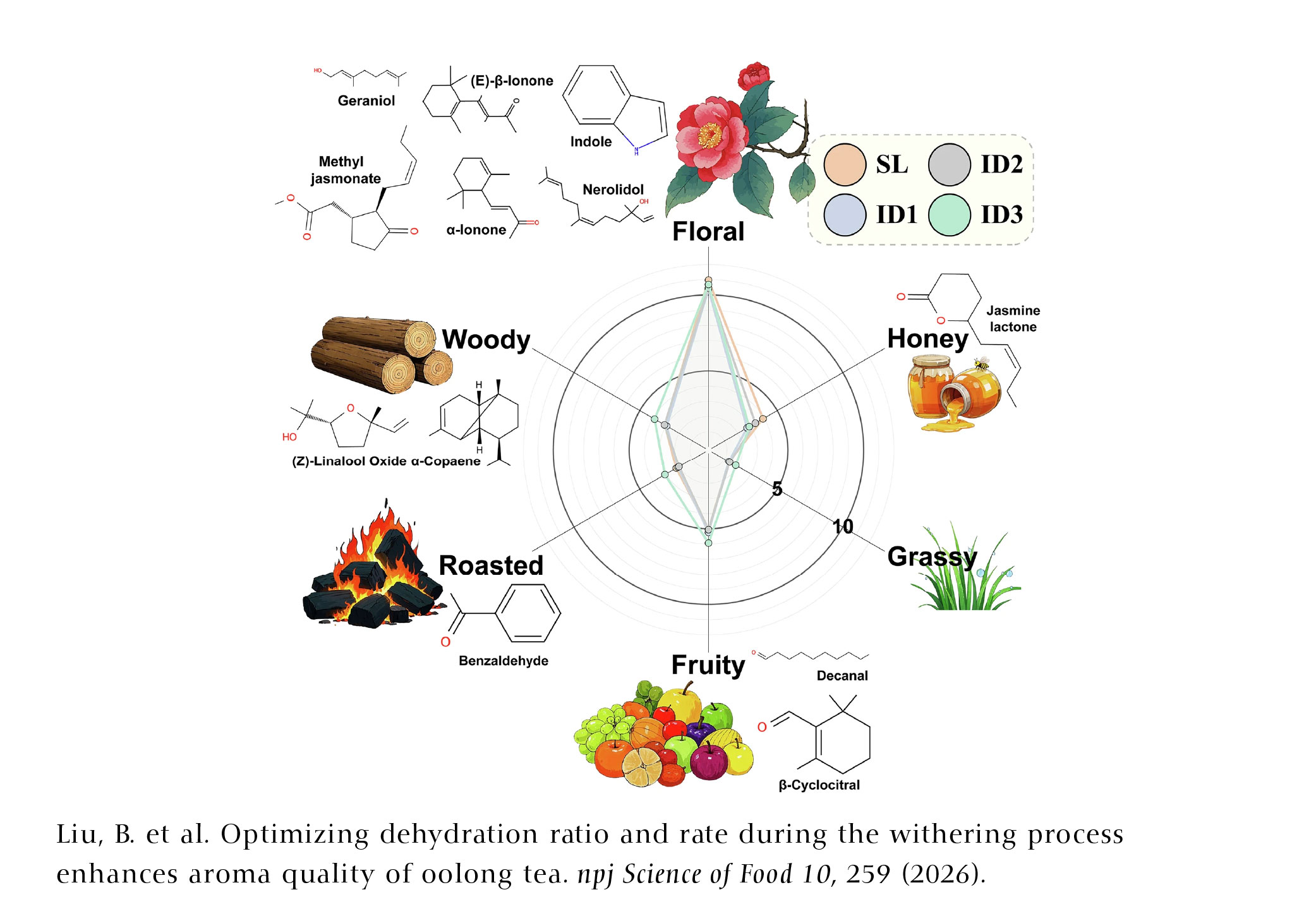
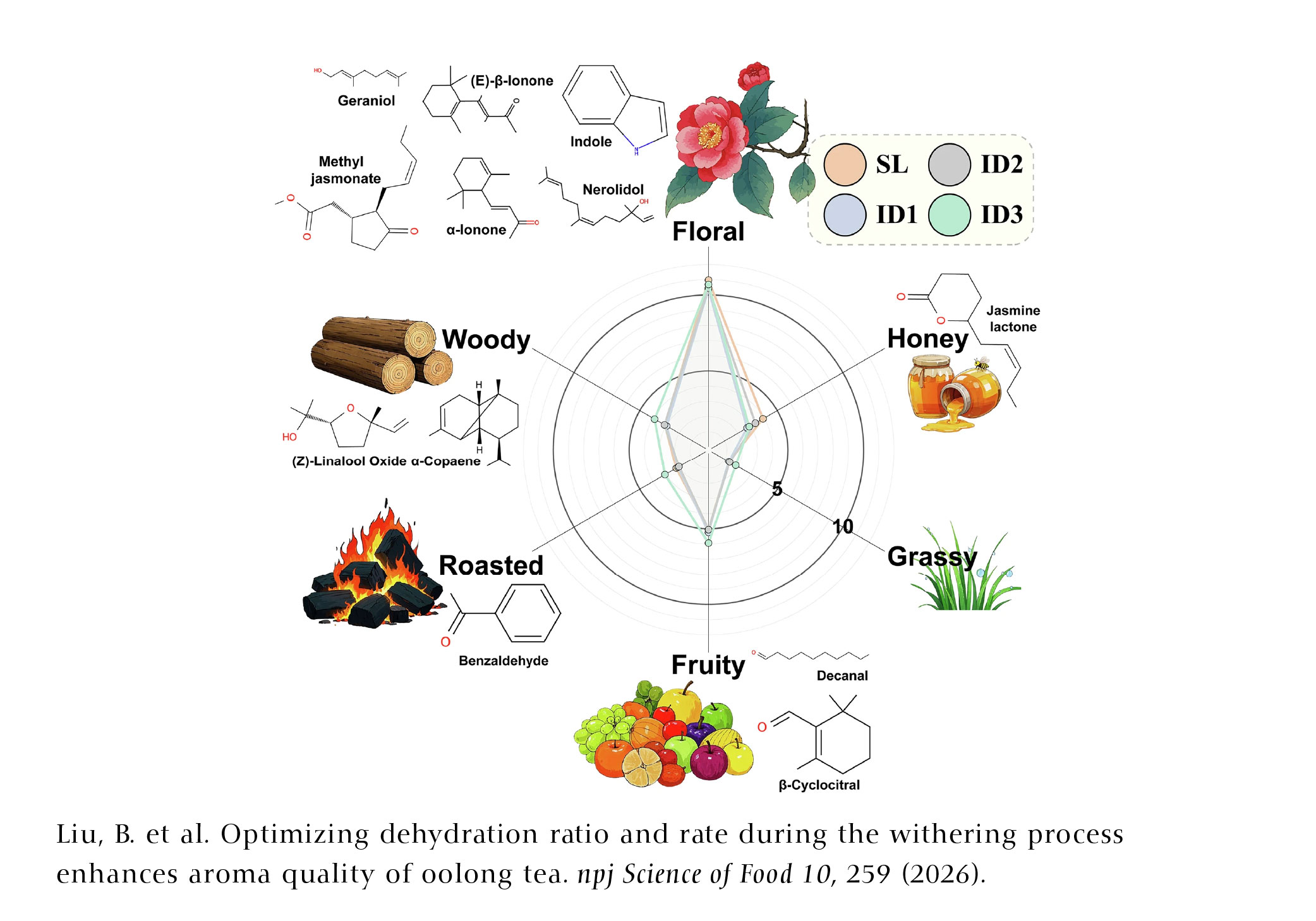
However, when the aroma was broken down by type,
the solar-withered tea was consistently strongest in floral and honey notes,
and the indoor groups could not match it however they were adjusted.
The airflow group stood out more in fruity, roasted and woody notes.
So the saying that sun-withered tea smells better is right, and it most likely refers to those floral and honey notes.
People in tea regions also say that "those who know how to run a hot-air withering trough can make tea just as good,"
and that holds true as well. It is not a matter of one being right and the other wrong;
the two simply produce different aroma profiles.
What Tea Regions Do on Rainy Days
The study set out to answer a practical question: what can be done when it rains and there is no sun?
This is a common problem in Taiwan too, where the plucking season in many tea regions coincides with the rainy season.
In practice, there are roughly three approaches.
Not Plucking at All
Leaves plucked in the rain carry surface water and are difficult to wither,
so many tea farmers would rather wait for the weather to improve.
It is a trade-off between quality and yield.
Withering Indoors Under Translucent Roofing
Translucent roofing keeps the rain off while letting in some natural light,
and the space is usually equipped with fans and dehumidifiers.
The dehumidifier is especially important: on rainy days the air is already full of moisture,
so fans alone cannot carry much water away.
Only by lowering the humidity can the rate of water loss be raised.
Seen in light of the study, this is all about letting the leaves lose enough water, and lose it fast enough.
Using a Hot-Air Withering Trough
Some places skip solar withering altogether and use a hot-air withering trough from the start.
Hot air allows both the amount and the rate of water loss to be controlled effectively,
and when operated well, the quality is just as consistent.
Light Through Translucent Roofing Is Not Sunlight
Speaking of translucent roofing, I have long had a question: while it keeps out the rain,
might it also keep out something in sunlight?
The study only compared "with sun" and "without sun.
" Sunlight, however, contains strong light, heat, ultraviolet and blue light all at once,
and the study did not separate which of these was doing the work.
The paper only mentions in passing that the formation of (Z)-3-hexenyl acetate may be linked to gene expression induced by blue light.
In practice, a few points are worth noting:
- Common polycarbonate (PC) roofing panels usually carry a UV-resistant coating to protect the panels themselves from aging, which ends up blocking most ultraviolet light.
- Polyethylene (PE) plastic sheeting with UV-stabilizing additives also lets less ultraviolet light through.
- As panels age, they yellow and turn hazy, reducing the transmission of visible light as well, and blue light is usually the first to be affected.
So even under the same name, "withering under translucent roofing," a different material,
or the same panel after several years of use, may mean the leaves receive very different light.
This may also be why the floral and honey notes of the indoor groups always fell a step short of solar withering.
The authors also suggest that LED-assisted withering that mimics the solar spectrum could be developed in the future to fill this gap.
Great Tea Is Shaped by Weather, Equipment and People
This study shows that withering is not simply a choice between "sun" and "no sun."
The amount of water lost decides whether the raw green note can be cleared,
the speed of water loss decides how high the floral aroma can climb,
and sunlight adds a layer of floral and honey fragrance that indoor methods cannot yet reproduce.
When the weather is good, the sun is a great help.
When it is not, it comes down to equipment, and even more to the tea maker's judgment:
whether to pluck, how to wither, and when to stop.
The next time you enjoy an oolong with a beautiful aroma, it may well be the result of many such decisions.
The fine aroma of an oolong depends not only on kind weather, but also on the experience and craft of the tea maker.
Hope this has been helpful. See you next time!
References
Liu, B. et al. Optimizing dehydration ratio and rate during the withering process enhances aroma quality of oolong tea. npj Science of Food 10, 259 (2026).
yoshantea #taiwantea #dongdingtea #oolongtea #teafactory #FSSC22000 #safetea #teaknowledge #solarwithering #teaprocessing #teascience #oolongaroma #teacraft