Hello everyone.
I'm Andy, a tea enthusiast.
I recently read two studies related to tea sensory science and chemical analysis.
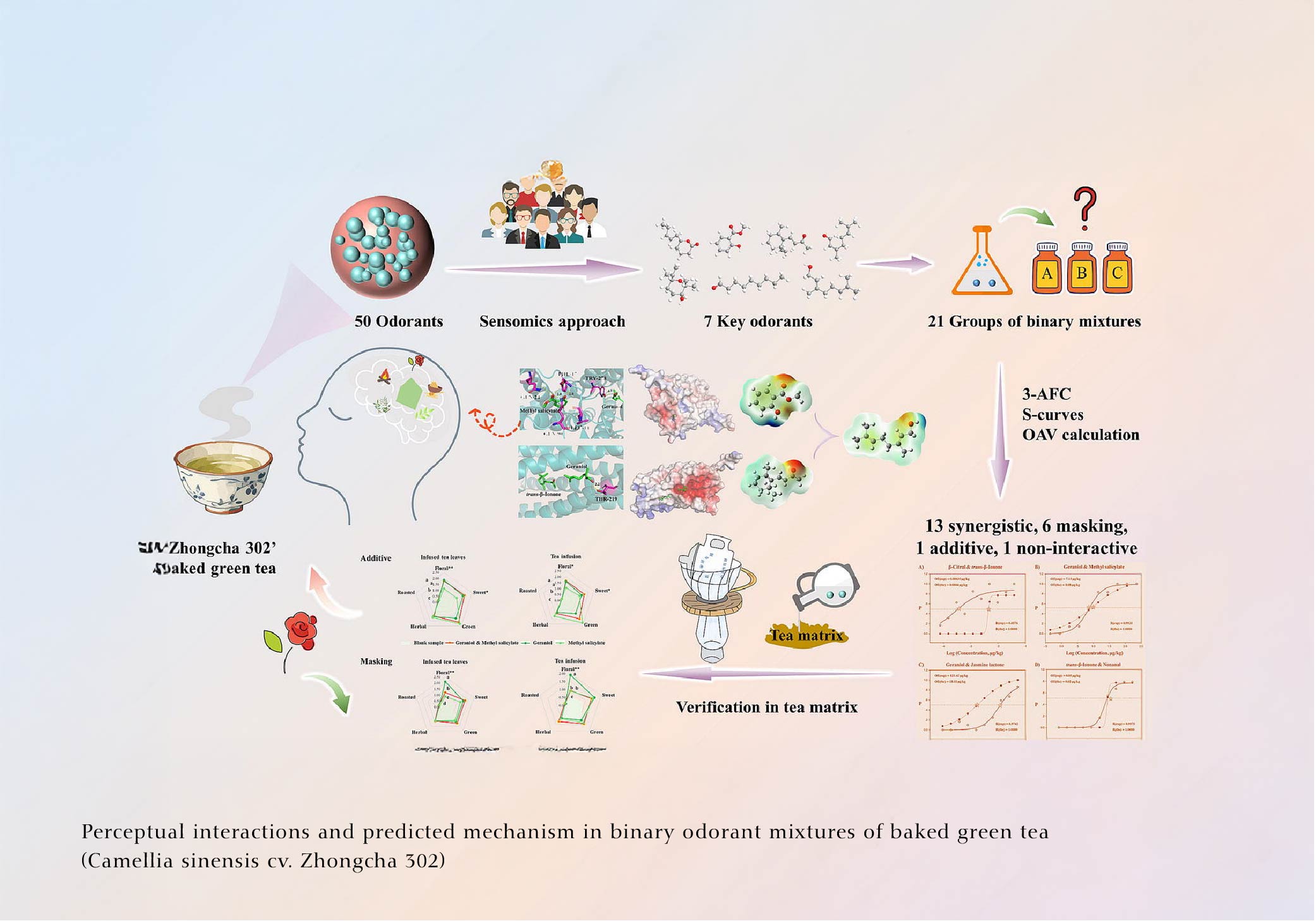
One examines odor interactions in Zhongcha 302 roasted green tea,
and the other uses Visible/Near-Infrared Spectroscopy (VIS/NIR) combined
with chemometrics to identify the origin of partially fermented teas.
Drawing on both papers, I want to explore whether instruments or chemical analysis can replace human sensory tasting.
Let me start with the conclusion. In the short term, probably not yet.
Chemical analysis can quickly map a tea's compositional profile,
but sensory perception is not simply the sum of compound concentrations.
It is a complex phenomenon full of interaction effects.
Tea's chemical composition underlies its flavor
What we taste in tea ultimately comes down to chemical signals received by our tongue and nose.
Catechins, the main polyphenols in tea, are the primary source of astringency.
Teas with lighter fermentation retain more catechins,
which is why green tea generally feels more astringent than fully fermented black tea.
Caffeine is a major contributor to bitterness,
and the intensity of bitterness in a tea liquor is often tied to the ratio of caffeine to certain catechins.
Theanine, a free amino acid, contributes sweetness and umami-like smoothness.
Soluble sugars in the tea liquor contribute sweetness directly.
Higher sugar content generally means a sweeter first impression.
Aroma is far more complex, made up of dozens to hundreds of volatile compounds.
The types and proportions of these compounds determine whether we perceive floral, fruity, honey, or roasted notes.
In other words, both flavor and aroma in tea have identifiable chemical explanations,
which is why more research is turning to chemical analysis to describe, and even predict, tea's sensory qualities.
Near-infrared light enables rapid compositional analysis
Once we understand the link between composition and flavor, the next step is measuring it quickly.
Traditional chemical methods such as GC-MS are precise but time-consuming and require specialized equipment and sample preparation,
making them impractical for real-time decisions during procurement or on the production line.
The second study uses visible/near-infrared spectroscopy to identify the composition of partially fermented teas,
such as oolong, sourced from Vietnam, China, and Taiwan.
Yet even with chemical composition mapped, human perception is not simply the sum of the parts
Things are not that simple, though. The odor interaction study on Zhongcha 302 makes this point clearly.
When two odor compounds are combined, human perception of intensity does not follow a straightforward sum.
Instead, synergistic or masking effects can appear. The same set of compounds,
depending on how they interact, may end up perceived as more or less intense than a simple sum would predict.
There's a familiar example of this in daily life.
When a watermelon isn't sweet enough, sprinkling a little salt on it can make it taste sweeter.
This is a contrast effect at work. But if you ran a chemical analysis,
salt itself contains no sugar and contributes nothing to sweetness on paper, yet it clearly changes what we perceive.
In other words, if you only look at a chemical composition table,
salt would barely register in a sweetness calculation, yet human perception clearly registers a difference.
The same holds true for tea's aroma and flavor.
Complex interactions between compounds are still difficult for current chemical analysis methods to fully capture.
AI may be the future solution, but it depends on continuous data accumulation
So is human sensory tasting truly irreplaceable?
I believe that, in the long run, AI has real potential to handle this kind of complex interaction,
since machine learning models are naturally suited to nonlinear relationships across multiple variables,
unlike traditional regression models that assume variables are independent and simply additive.
There's a condition here, though.
For AI to learn the patterns behind these interactions, it needs a large,
continuously growing dataset pairing sensory and chemical data.
A handful of samples won't be enough to train a reliable model.
This reminds me of a line from Hao Xu Lie's book "享受蛻變" (Embracing Transformation):
success has no miracles, only accumulation.
That line applies just as well to AI-assisted tea tasting.
Without a sufficiently large database,
even the most capable model will struggle to truly understand the complex relationships behind tea's sensory qualities.
To sum up, my view on whether chemical analysis and AI can replace human sensory tasting is this:
they can become valuable tools that support tasting, helping us grasp compositional profiles faster.
But fully replacing human senses will still take much longer,
requiring far more data accumulation and model validation.
Hope this has been helpful.
See you next time.
#yoshantea #taiwantea #dongdingtea #oolongtea #teafactory #FSSC22000 #safetea #teaknowledge #sensorytasting #chemicalanalysis #nearinfraredspectroscopy