Hello everyone,
I am Andy, a tea enthusiast.
If you work in tea export, you may have noticed that Taiwan's pesticide residue test reports for tea do not always meet the requirements of the destination market.
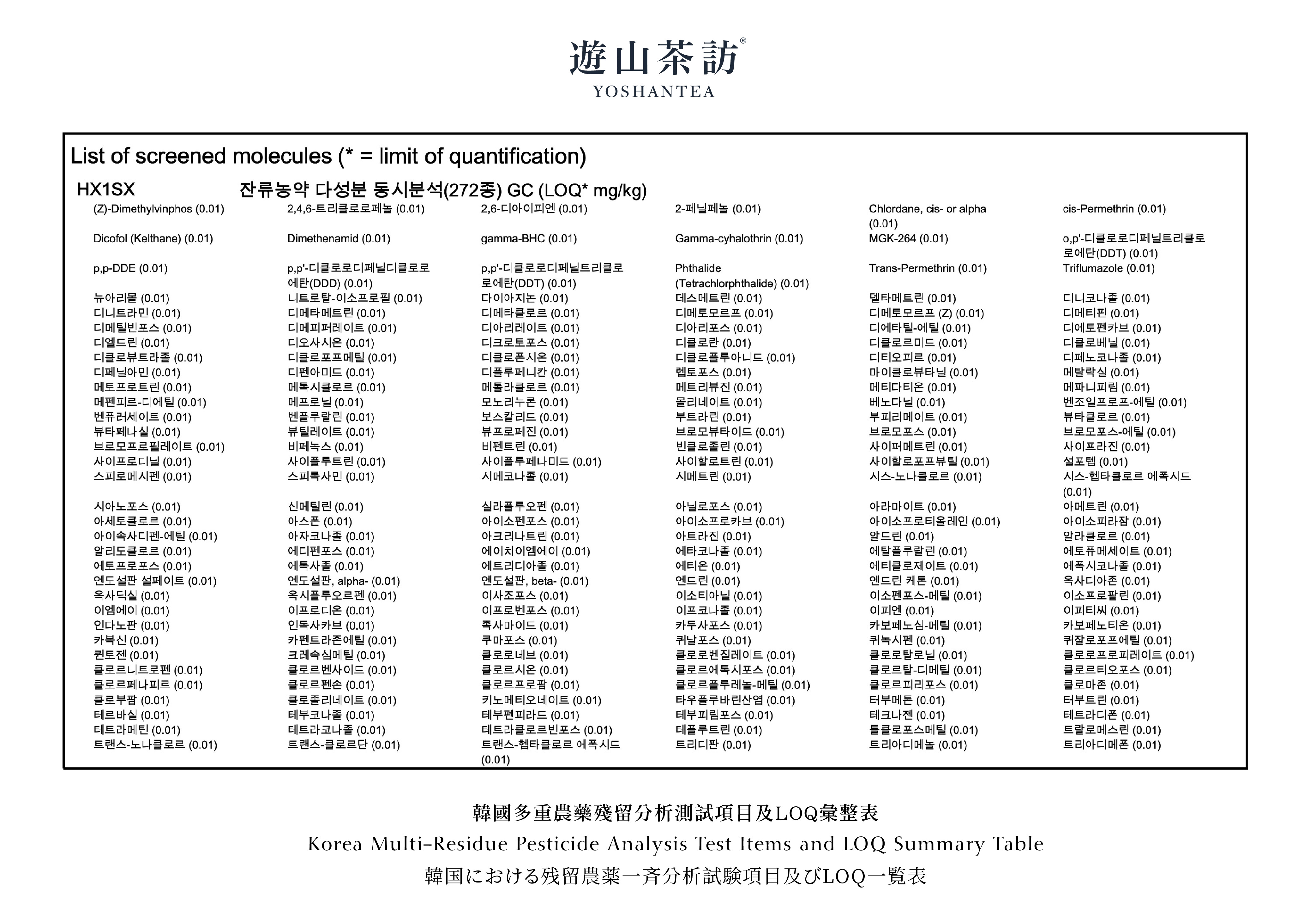
Neighboring countries such as South Korea and Japan, and further away in Europe, often use different thresholds. Take fluopyram as an example. Under Taiwan regulation, the limit of quantitation (LOQ) for fluopyram is 0.05ppm. Japan has no crop-specific standard for fluopyram in tea, so its uniform standard applies at 0.01ppm, which in practice means the test method needs to reliably detect down to 0.01ppm or below.
If the fluopyram level in a tea sample is below 0.05ppm, the Taiwan test report will show it as not detected. This can become an export risk.
This time I want to share why Taiwan's tea pesticide residue LOQ is not 0.01ppm.
For most items on Taiwan's tea pesticide residue reports, the limit of quantitation (LOQ) sits at 0.05ppm. This is not because regulation prohibits labs from reaching 0.01ppm. It reflects a trade-off driven by the complexity of tea as a dry matrix, combined with an official method that has to cover hundreds of pesticides at once.
Three concepts worth separating
When discussing pesticide testing, it helps to separate three different things: the analyte, the limit of quantitation, and the regulatory limit.
The analyte answers which pesticide or metabolite the lab actually tested for.
The limit of quantitation (LOQ) answers the lowest concentration the method can reliably quantify.
The maximum residue limit (MRL) answers the highest concentration the law allows.
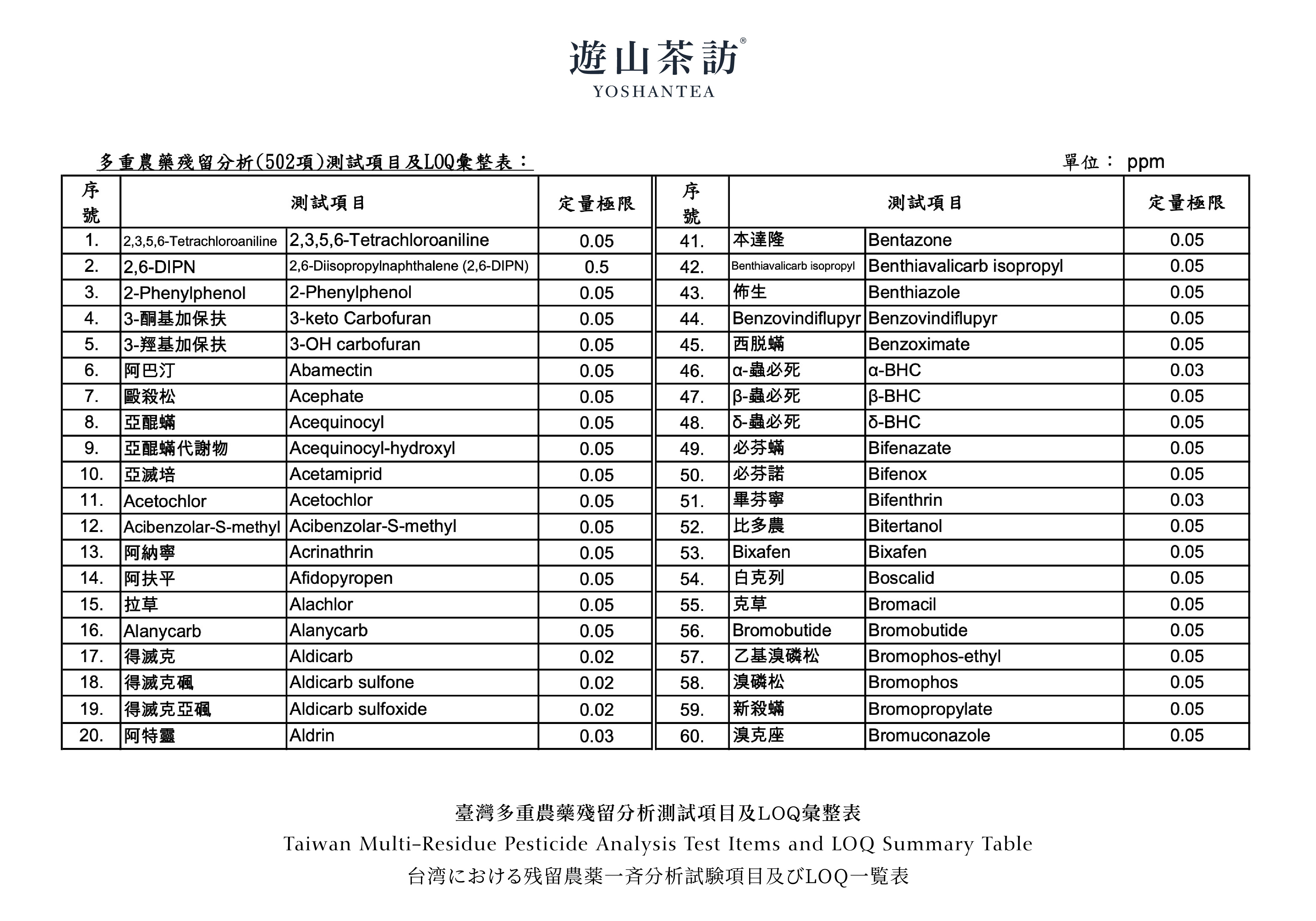
For example, if a batch of tea shows bifenthrin at 0.04ppm, bifenthrin is the analyte, and if the method LOQ is assumed to be 0.03ppm, then 0.04ppm can be formally quantified. Taiwan's MRL for bifenthrin in tea is 2.0ppm, so 0.04ppm is far from exceeding the limit. LOQ describes the performance of the method itself, while MRL is the legal line drawn by regulation. The two are different in nature.
What the pesticide residue limit citation means
Test reports often cite a line stating that Taiwan's tolerance follows an order issued by the Ministry of Health and Welfare's Food and Drug Administration on a certain date, amending the Standards for Pesticide Residue Limits. Take the amendment dated April 21, 2026 as an example. This revision amended Appendix 1 of Article 3 of the Standards for Pesticide Residue Limits, covering revisions or additions for dozens of pesticides across over a hundred pesticide crop combinations, removing residue limits for pesticides no longer approved for use, clarifying that crop-specific MRLs take priority over broader category MRLs when both exist, and updating certain crop names and pesticide use categories.
What this citation really means is which version of the regulation the Taiwan tolerance column in the report refers to, so it is not confused with an older version or with standards from other countries such as Japan or the EU.
What the residue test method notation means
Reports often include a note that the 410 items refer to the items covered under the Ministry of Health and Welfare's published Multiple Residue Analysis Method (V) for pesticide residues in food. This refers to method number MOHWP0055.05, announced under order number 1111901537, published on August 17, 2022, effective January 1, 2023, based on Article 38 of the Act Governing Food Safety and Sanitation, covering 410 pesticide and related analyte items.
One detail worth noting is that 410 items does not mean 410 individual pesticides. The analytes may include active ingredients, isomers, metabolites, breakdown products, and related components required by the regulatory residue definition. A more precise description is 410 pesticide analytes or test items, rather than 410 pesticides legally approved for use in tea gardens.
The method itself uses QuEChERS sample preparation, extracting with acetonitrile, salting out and removing water with magnesium sulfate and other salts, followed by dispersive solid phase extraction cleanup. Polar, less volatile, or heat unstable pesticides are analyzed by LC-MS/MS, while more volatile and heat stable pesticides are analyzed by GC-MS/MS. The official method classifies foods into categories I, II, and III based on matrix characteristics. Tea, dried spices, and other complex dried herbal plants are usually classified as category III, which directly relates to the LOQ differences discussed later.
How to check approved pesticides for tea in Taiwan
To confirm whether a pesticide is approved for use on tea, you can search Taiwan's Ministry of Agriculture official website.
1. Go to the Plant Protection Information System.
2. Search "tea" to see the full list of approved products for tea plants.
3. You can also search "tea plus pest name," for example "tea plus tea green leafhopper," to find recommended products for a specific pest.
4. Check the product details to confirm the active ingredient, product name, dilution ratio, number of applications, and pre-harvest interval.
5. If you know the product name or registration number, you can verify whether the registration is valid through the Pesticide Information Service registration lookup.
6. Before use, confirm that the product label explicitly covers "tea" and follow the label instructions.
Plant Protection Information System:
https://otserv2.acri.gov.tw/ppm/
Pesticide Information Service:
https://pesticide.aphia.gov.tw/information/
Registration lookup:
https://pesticide.aphia.gov.tw/information/Query/Register
Pesticide search and residue standards:
https://m.moa.gov.tw/Pesticide/Index
https://consumer.fda.gov.tw/Law/PesticideList.aspx?nodeID=520#
Do not judge by active ingredient name alone. Different products, formulations, or concentrations of the same active ingredient may have different approved uses and pre-harvest intervals. The Ministry of Agriculture also recommends verifying pesticide registration, usage method, and approved scope through the Pesticide Information Service.
How the 502 item panel relates to the 410 item method
Some private labs advertise a "502 item multi residue analysis." Of these 502 items, 410 overlap with the items published under MOHWP0055.05, while the remaining 92 are items the lab added on its own. This panel may reference AOAC 2007.01 to build a QuEChERS workflow, but this does not mean all 502 items are officially published items, nor that the operating conditions and LOQ fully follow the official method. Overlapping items and using an identical method are two different things.
To confirm a lab's actual capability, it is worth asking for the 410 item official comparison table, the list of 92 added items, the LC-MS/MS or GC-MS/MS split for each item, item by item LOQ in tea matrix, a method validation summary, recovery rate, precision and measurement uncertainty, and the scope of FDA or TAF accreditation.
How the limit of quantitation is established
LOQ is defined as the lowest concentration at which quantitation can still be performed with adequate accuracy and precision. It is not the lowest concentration at which a number simply appears on the instrument screen, and it is not something a lab can claim just because a small peak is visible.
Under the FDA's Validation Guidelines for Food Chemistry Test Methods, LOQ is typically evaluated through the standard deviation of blank or low concentration samples combined with calibration curve slope, the signal to noise ratio (usually requiring a quantitation signal with S/N of 10 or above), and spiking known amounts of pesticide into low concentration matrix to confirm recovery and repeatability meet requirements.
In other words, if a lab wants to claim a tea LOQ of 0.01ppm, it needs to demonstrate that the blank tea matrix shows no significant interference, that 0.01ppm produces sufficient quantitation and identification signal, that spike recovery meets requirements, that repeated measurements show reasonable variation, that precision holds across different days, staff, or equipment, that the calibration curve covers 0.01ppm, that recovery remains stable after full extraction and cleanup, that matrix effects in tea are controlled, and that measurement uncertainty is acceptable.
Why most Taiwan tea LOQs sit at 0.05ppm rather than 0.01ppm
The main reason is not that the law prohibits 0.01ppm, but that tea is a dry matrix that is analytically difficult to work with.
Tea contains large amounts of tea polyphenols, caffeine, chlorophyll and other pigments, essential oils and fat soluble substances, and various dried and concentrated natural compounds. These substances may be extracted alongside the pesticides, interfere with mass spectrometry ionization, cause signal suppression or enhancement, produce interference peaks close to the retention time of certain pesticides, and reduce recovery and repeatability at low concentrations.
On top of this, the official method has to cover 410 items at once, and private panels even expand this to 502 items. These pesticides differ greatly in polarity, volatility, thermal stability, ionization efficiency, and extraction recovery. Optimizing for one or a few pesticides makes 0.01ppm easier to reach, but making hundreds of pesticides stably reach 0.01ppm across various tea matrices is far more difficult from a technical and validation standpoint. The official method therefore balances a large number of test items, reproducibility across labs, routine testing efficiency, instrument availability, and method robustness. The trade-off is that many tea category items have a published LOQ that remains at 0.05ppm.
Looking back at how this evolved supports this point. The first version of Method (V) in 2012 covered only 213 items. At that time, the detection limit for tea, dried spices, and other dried herbal plants was set at 5 times the general listed value. This meant a general value of 0.01ppm became 0.05ppm for tea, and a general value of 0.05ppm became 0.25ppm for tea. In 2014, the 213 items expanded to 310, adopting QuEChERS and setting tea specific LOQ item by item. Most changes were actually reductions, for example chlorfenapyr dropped from 0.25ppm to 0.10ppm, imidacloprid from 0.25ppm to 0.05ppm, fenpropathrin from 0.40ppm to 0.05ppm, and bifenthrin from 0.15ppm to 0.05ppm. This was followed by expansion to 373 items (published 2017, effective 2018), 380 items (published 2019, effective 2020), and the current 410 items (published 2022, effective 2023), which became MOHWP0055.05.
Looking at the full picture, the 0.05ppm figure for most items did not come from relaxing a former 0.01ppm standard. It came from the earlier 5 times rule for tea category items, combined with later reductions from values such as 0.15ppm, 0.25ppm, or 0.40ppm.
Understanding "not detected" correctly
When a report lists a pesticide's LOQ as 0.05ppm, a complete absence of instrument signal is reported as not detected. A weak signal with an estimated value below 0.05ppm may also be reported as not detected. Only a result at or above 0.05ppm that meets identification criteria can be formally quantified. So a more precise meaning of "not detected" is "not detected above the limit of quantitation of this method." A more transparent way to report this is to write "less than 0.05mg/kg," "below the limit of quantitation," or "ND with LOQ noted," which is less likely to be misread as meaning the substance is completely absent.
Summary
Taiwan's Standards for Pesticide Residue Limits set the legal maximum residue level for pesticides in specific foods. The Ministry of Health and Welfare's Multiple Residue Analysis Method (V) sets the testing workflow and matrix specific LOQ for 410 pesticide analytes. The two serve different purposes. Because tea is a dry food with a complex matrix, the official multi residue method sets an LOQ of 0.05ppm for many items, though not every item is 0.05ppm.
Looking ahead, worthwhile directions include gradually lowering more tea pesticide LOQs to 0.01ppm, clearly listing every test item in formal reports, and replacing the easily misunderstood "not detected" with a 0.01ppm limit of quantitation where possible.
When Taiwan tea is exported, the destination country does not take into account whether tea is a complex matrix. Using 0.01ppm as the limit of quantitation is the safest approach.
Pesticide residue exceeding the limit is a far more serious regulatory issue than tea simply not tasting good.
Improving tea food safety is the foundation for building Taiwan tea's international competitiveness.
Hope this has been helpful.
See you next time.
yoshantea #taiwantea #dongdingtea #oolongtea #teafactory #FSSC22000 #safetea #teaknowledge #pesticideresidue #LOQ #teaexport #foodsafety