Hello everyone,
I'm Tea Enthusiast Andy.
Among all the steps in making oolong tea,
controlling the degree of fermentation (oxidation) is the most difficult to master.
When I first started learning about tea, my father would always say,
"Smell it — do you notice that grassy green smell? That means it's not good."
Back then, I was genuinely puzzled.
That aroma smelled quite nice to me, even a little sweet. Why was it considered bad?
Besides smelling the tea, there is actually a very intuitive visual method to judge the degree of oxidation.
Let's talk about that today.
What Is Tea Fermentation (Oxidation)?
The "fermentation" in oolong tea refers to the process in which tea leaf cells are broken down during rolling and stirring.
Once the cell sap comes into contact with air, polyphenol oxidase catalyzes the oxidative polymerization of catechins,
forming pigment compounds such as Theasinensins, theaflavins, and thearubigins.
These changes transform the color, aroma, and flavor of the brewed tea.
The scientifically accurate term for this process is "oxidation." The word "fermentation"
is simply an industry convention that has been passed down over time.
Why Can't We Use Equipment to Judge Oxidation?
You might wonder: with all the advanced technology available today,
can't we just use instruments to measure oxidation levels in real time?
In theory, yes. But in practice,
it's very difficult. Oxidation reactions happen extremely fast,
and each batch of tea leaves differs in moisture content, leaf thickness, temperature, and humidity.
No instrument can keep pace with all these variables simultaneously.
More importantly, the signals from "aroma transformation" and "leaf appearance" are often faster and more direct than any device.
That is why the five senses of an experienced tea master remain the most reliable tool.
What Methods Are Used to Judge Oxidation Level?
Smelling is the most instinctive approach.
The aroma progresses from a raw grassy note (qing wei) to a mature leaf scent,
then to a delicate floral note, and finally to sweet, honey, or fruity aromas. Each stage indicating deeper oxidation.
Observing the degree of wrinkling on the stem: the stem surface transitions from taut and smooth to showing longitudinal wrinkles,
indicating that moisture is redistributing from the stem back into the leaf (xing shui). This is an important marker during oxidation.
Observing the overall shape of the leaves: the leaf margins begin to show reddening, and the leaves shift from bright green to deep olive green.
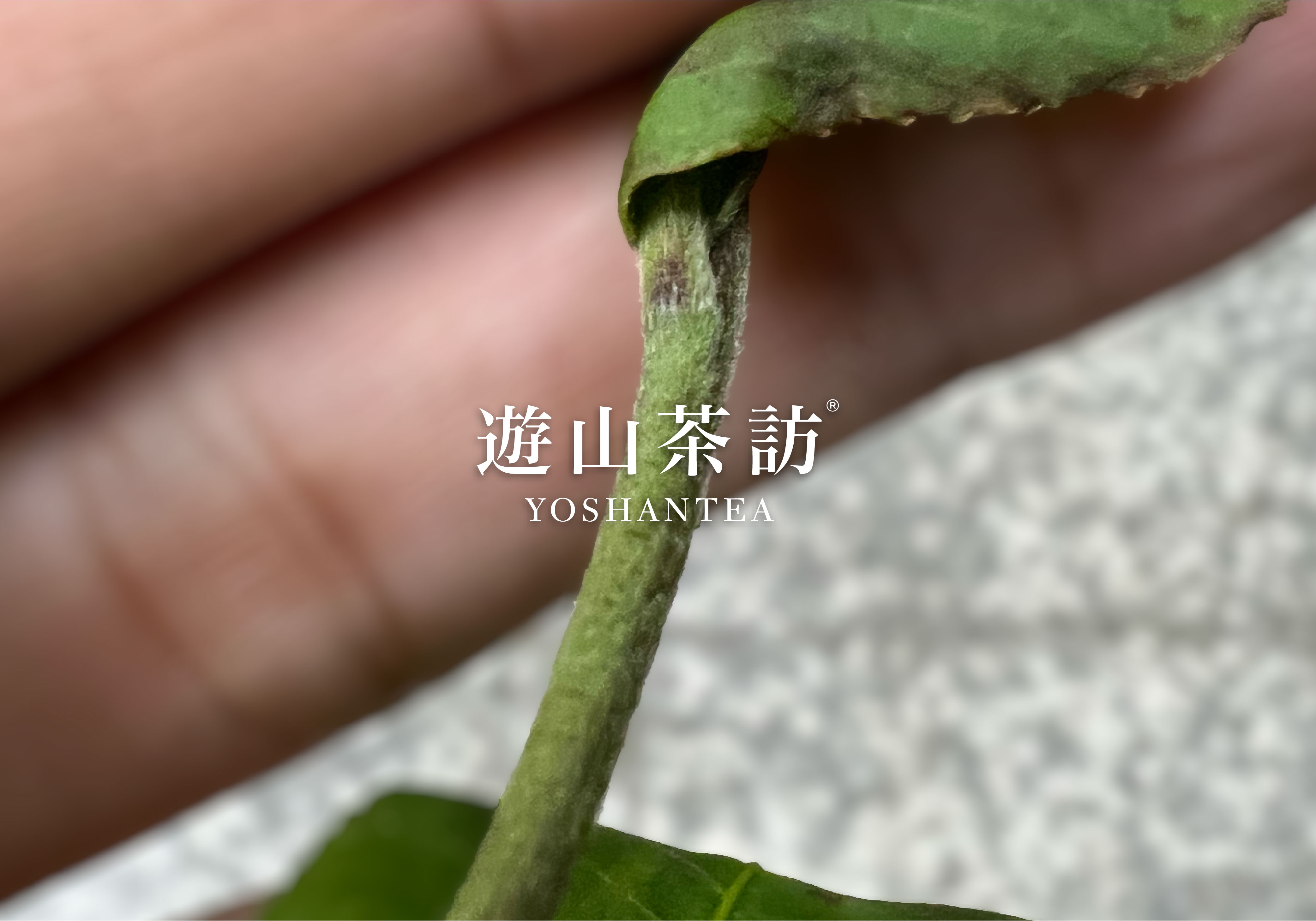
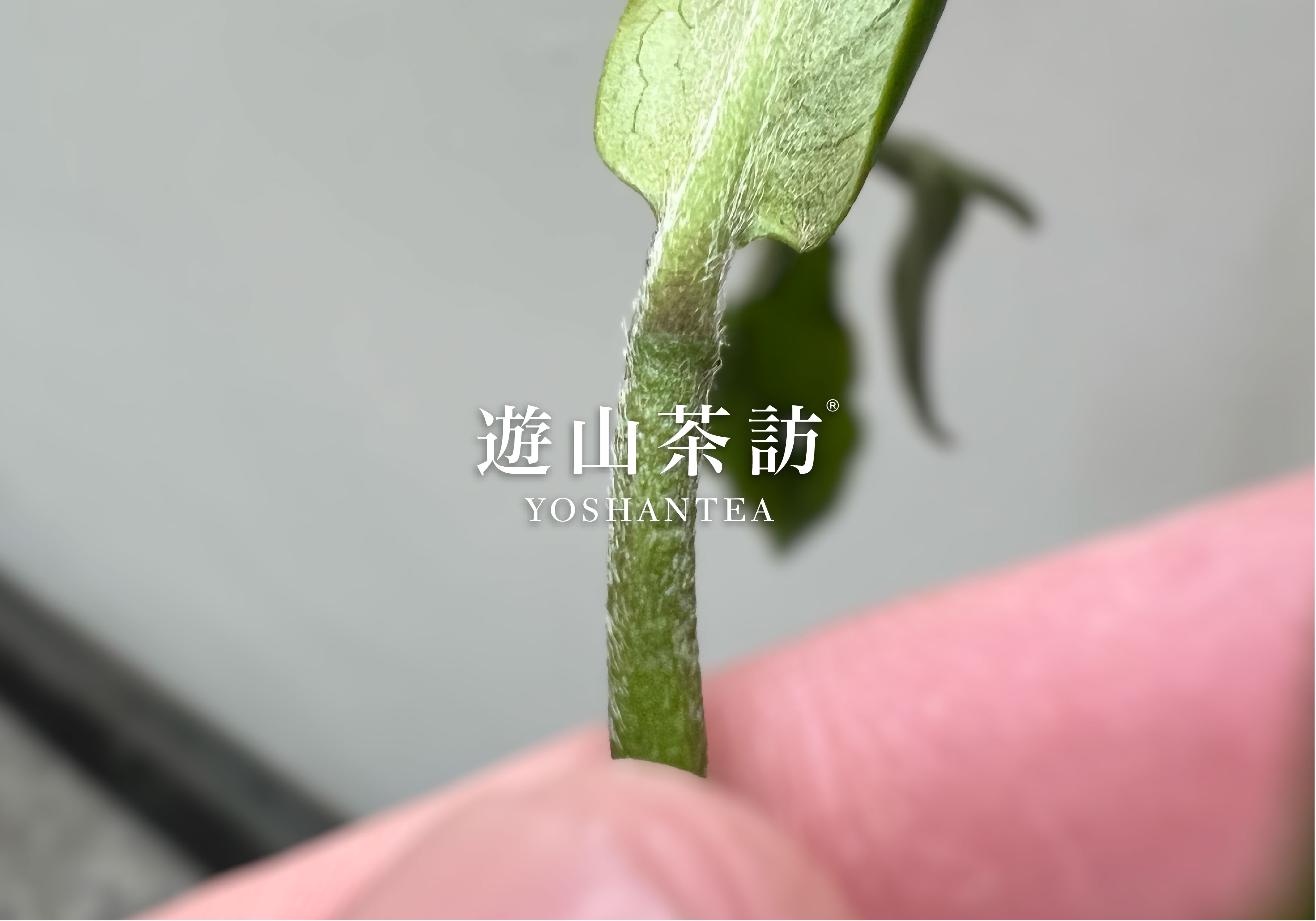
Observing the junction between the leaf and the stem is one of the most precise visual methods, and the focus of this article.
How to Judge Oxidation Level with the Naked Eye
In the production environment, the spot tea masters most often watch is the junction between the petiole and the stem.
This junction undergoes a sequential color change as oxidation progresses:
It begins as a pale pink or light red, deepens into rose red, and finally turns dark purple-red.
Before the color becomes too deep, that signals oxidation has reached its peak.
It is time to immediately perform kill-green (fixation) (sha qing) to stop oxidation.
If this moment is missed, the leaf will detach from the stem entirely.
This discolored junction has a distinctive name in the industry: the pigeon's eye.
The Science Behind the Pigeon's Eye: Abscisic Acid (ABA)
The appearance of the pigeon's eye is closely related to the plant hormone abscisic acid (ABA).
ABA is a signaling molecule synthesized by plants under stress conditions such as drought or physical damage.
One of its key roles is to promote leaf abscission.
During tea processing, as the leaves are stirred and rubbed, the leaf cells are damaged,
causing ABA concentrations to rise at the abscission zone at the base of the petiole.
This triggers cell wall degradation in the abscission zone, gradually loosening the connection between the leaf and the stem.
Simultaneously, pigment compounds formed from the oxidation of catechins accumulate at the petiole base.
Combined with the contribution of anthocyanins and other pigments,
this produces the characteristic color shift from pink to deep purple.
What we observe as the pigeon's eye.
I hope this article has been helpful.
See you next time.
#yoshantea #taiwantea #dongdingtea #oolongtea #teafactory #FSSC22000 #safetea #oxidation #pigeonseye #teamaking